Creative Courage: Designing Environments That Unlock Bold Innovation Through Biophilic Elements

Key Takeaways Before You Read the Full Article:
30 Second Executive Summary
Creative courage requires environments that support experimentation, reduce stress, and encourage new ways of thinking. Preserved gardens and moss walls help create psychologically safe workplaces where innovation, collaboration, and breakthrough ideas can flourish.
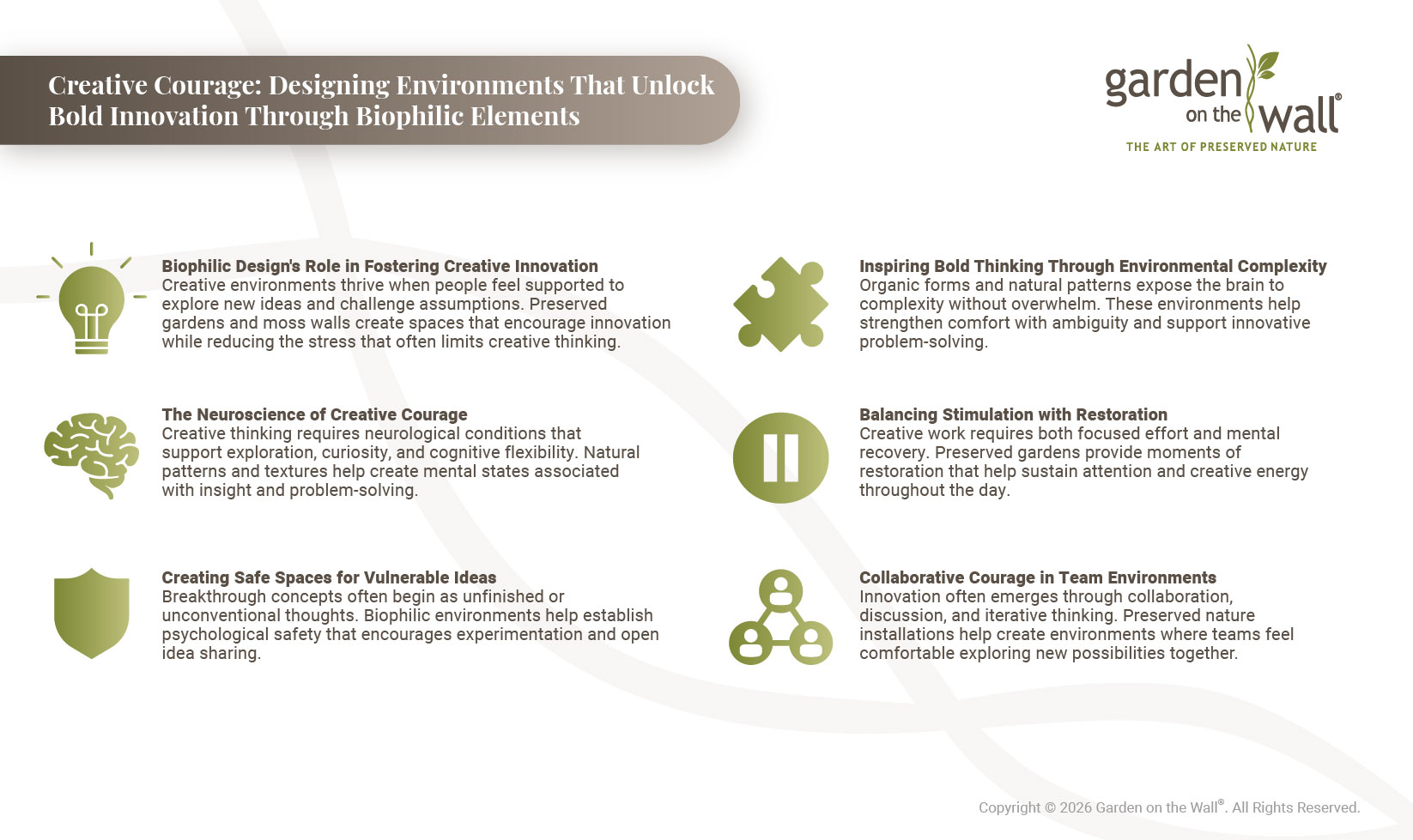
💡 Innovation Support: Designing for Bold Thinking
Biophilic environments help reduce the stress responses that often limit creative exploration. Preserved gardens encourage curiosity, experimentation, and innovative thinking.
🧠 Research Foundation: The Neuroscience of Creativity
Natural patterns and textures support cognitive flexibility and creative insight. These environments help the brain move beyond conventional thinking patterns.
🛡️ Psychological Safety: Creating Space for New Ideas
Innovation depends on environments where people feel comfortable sharing unfinished concepts. Preserved nature installations help foster confidence, openness, and creative risk-taking.
🧩 Environmental Complexity: Encouraging Sophisticated Problem-Solving
Organic forms expose teams to visual complexity that supports creative thinking. These environments strengthen comfort with ambiguity and multi-dimensional challenges.
🤝 Collaborative Innovation: Supporting Team Creativity
Biophilic environments help create more productive and exploratory discussions. Teams are better equipped to build on ideas and pursue innovative solutions together.
Ready to discover how workplace design can unlock greater creativity and innovation? The full article explores how preserved gardens and moss walls help create environments that support bold thinking, collaboration, and breakthrough ideas.
Biophilic Design's Role in Fostering Creative Innovation
Creative courage - the willingness to pursue bold, innovative ideas despite uncertainty and potential failure - represents a crucial competitive advantage in today's rapidly evolving business landscape. Organizations across industries recognize that breakthrough innovations require environments that support risk-taking, experimental thinking, and creative confidence. However, many workspaces inadvertently inhibit creative courage through sterile, uninspiring designs that trigger stress responses and conservative thinking patterns rather than encouraging bold innovation.
Environmental psychology research reveals that biophilic design elements significantly enhance creative thinking and risk-taking behaviors essential for innovation. Natural environments and nature-inspired spaces activate the parasympathetic nervous system, reducing stress-induced cognitive restrictions that limit creative exploration. Preserved gardens, moss walls, and planter inserts create environments that support the psychological safety and mental flexibility required for breakthrough thinking while eliminating maintenance concerns that could distract from creative focus.
The Neuroscience of Creative Courage
Creative risk-taking requires specific neurological conditions that allow the brain to move beyond safe, conventional thinking patterns. The prefrontal cortex must feel secure enough to explore unusual connections while the limbic system remains calm enough to avoid triggering defensive responses that shut down innovative thinking.
Research in neuroaesthetics reveals that natural patterns and textures activate the brain's default mode network - the neural system responsible for creative insight and innovative problem-solving. When designers work in environments enhanced with preserved moss walls and garden installations, their brains naturally shift into states that support creative exploration rather than self-protection. The organic complexity found in preserved nature installations provides what researchers call "optimal cognitive load" - enough visual interest to stimulate creative thinking without overwhelming the mental resources needed for complex problem-solving.
Creating Safe Spaces for Vulnerable Ideas
The most innovative design concepts often emerge from ideas that initially seem impractical, strange, or even foolish. These fragile creative seeds require protective environments where they can develop without premature judgment or criticism. Traditional studio environments - with their clean lines, neutral colors, and professional aesthetics - often signal professionalism at the expense of creative permission.
Preserved nature installations transform studio environments by introducing elements that suggest growth, experimentation, and natural evolution. The presence of organic forms signals that imperfection, irregularity, and ongoing development are not only acceptable but valued. This environmental messaging creates psychological permission for designers to share early-stage ideas without fear of immediate evaluation, while moss walls and preserved garden installations provide visual metaphors for creative processes that develop through complex interactions and patient cultivation.
Inspiring Bold Thinking Through Environmental Complexity
Natural environments have inspired human creativity for millennia but living installations in commercial spaces often create maintenance challenges that distract from their creative benefits. Preserved nature installations eliminate these practical concerns while maintaining the visual complexity that stimulates innovative thinking.
The intricate patterns found in preserved moss walls mirror the complexity of design challenges themselves. When designers regularly encounter these organic puzzles in their peripheral vision, their brains develop increased comfort with complexity and ambiguity - essential skills for navigating sophisticated design problems that don't have obvious solutions. Draping preserved foliage creates three-dimensional environments that encourage spatial thinking and multi-dimensional problem-solving, suggesting layered solutions and interconnected approaches that unlock more sophisticated design strategies.
Balancing Stimulation with Restoration
Creative work demands intense periods of focused thinking alternated with restorative breaks that allow unconscious processing. Effective creative environments must support both focused concentration and mental restoration without requiring designers to leave their workspace or significantly disrupt their workflow.
Preserved nature installations provide ongoing opportunities for micro-restoration that support sustained creative effort. Brief moments of visual contact with organic textures and patterns allow the brain to reset attention systems without requiring extended breaks. Planter inserts with preserved foliage offer flexible solutions that can be adjusted based on project requirements - positioned to maximize visual inspiration during brainstorming phases or arranged to minimize distraction while maintaining restorative benefits during execution phases.
Collaborative Courage in Team Environments
Individual creative courage is challenging enough, but collaborative creativity requires additional layers of psychological safety where team members feel secure enough to build on each other's ideas, challenge assumptions, and explore concepts that might fail spectacularly.
Preserved moss walls create visual backdrops for collaborative sessions that suggest organic growth and interconnection. Teams working in these environments often develop increased comfort with iterative processes and collaborative refinement that mirrors natural development patterns. Conference areas enhanced with preserved garden installations encourage longer, more exploratory discussions, as the calming influence of biophilic elements reduces the stress responses that can make teams default to safe, conventional solutions when facing deadline pressure.
Implementation Strategies for Creative Spaces
Successful integration of preserved nature installations in creative environments requires understanding the specific workflow patterns and creative processes unique to each studio. Different design disciplines have varying requirements for individual focus, collaborative work, presentation preparation, and client interaction.
Begin by identifying the spaces where creative courage is most needed - brainstorming areas, early concept development zones, and spaces where difficult creative decisions are made. These locations benefit most from the psychological safety provided by preserved gardens and moss walls. Garden on the Wall®'s custom design capabilities allow creative studios to develop preserved installations that reflect their unique creative philosophies while providing the psychological benefits of nature connection, ensuring that environmental support for creativity aligns with each studio's specific aesthetic and functional requirements.
The Future of Creative Environments
As creative industries become increasingly competitive and client expectations continue rising, the ability to consistently produce innovative work becomes a crucial competitive advantage. Environmental design that actively supports creative courage provides strategic value that extends far beyond aesthetic benefits.
Commercial interior designers working with creative clients have opportunities to create competitive advantages through thoughtful biophilic interventions. Preserved gardens, moss walls, planter inserts, and draping preserved foliage can transform ordinary creative spaces into environments that actively support the bold thinking required for industry leadership. The future belongs to creative teams that can consistently access their full innovative potential, and with strategic environmental design, these teams can develop the creative courage necessary to pursue the ambitious projects that define careers and transform industries.
For more information on this subject, read this article: Regenerative Office Design: Moving Beyond Net-Zero to Spaces That Actively Restore Human Energy and other related information, please visit our website: www.gardenonthewall.com.