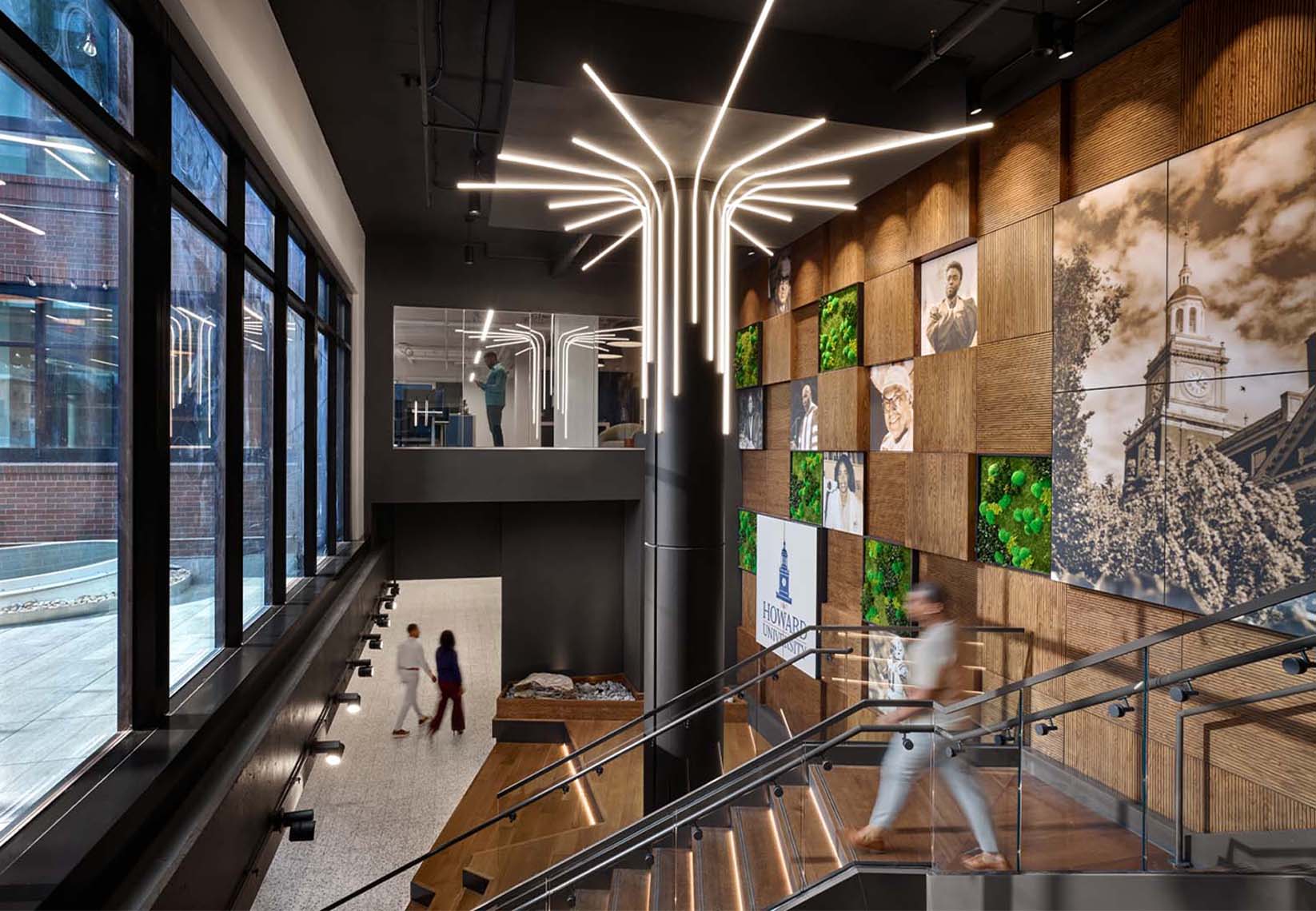
Regenerative Office Design: Moving Beyond Net-Zero to Spaces That Actively Restore Human Energy

Key Takeaways Before You Read the Full Article:
30 Second Executive Summary
Regenerative office design moves beyond net-zero goals to create workplaces that actively restore human energy and vitality. Through preserved gardens, moss walls, and planter inserts, offices become environments that replenish cognitive, emotional, and physical resources rather than depleting them.
💼 Business Impact: Energy-Restoring Workplaces as Competitive Advantage
Regenerative design reframes preserved gardens as strategic infrastructure that supports sustained performance, engagement, and organizational resilience. By restoring human energy, these environments help organizations maintain productivity and adaptability over time.
🔬 Research Foundation: Restoring Human Energy Through Design
The approach aligns with research showing that exposure to natural patterns improves attention capacity, stress regulation, and emotional resilience. Preserved gardens provide consistent restorative cues that support cognitive recovery and long-term well-being.
🎯 Strategic Implementation: Designing for Energy Flow and Renewal
Thoughtful zoning and placement create natural rhythms that support energy restoration throughout the workday. Preserved gardens integrate seamlessly into circulation paths and transition zones, offering repeated moments of renewal without operational disruption.
📊 Long-Term Value: Compounding Regenerative Returns
Energy-restoring environments deliver cumulative benefits through improved resilience, creativity, and sustained performance. Over time, these regenerative outcomes demonstrate why offices designed to restore rather than extract human energy outperform conventional workplace models.
Ready to explore how offices can move beyond net-zero to actively restore human energy? The full article examines how regenerative design with preserved gardens creates workplaces where vitality and performance continuously reinforce one another.
Net-zero buildings prevent environmental harm - regenerative design with preserved gardens, moss walls, and planter inserts crafted with preserved foliage actively restores both environmental and human health while creating positive impacts that compound over time. This revolutionary approach transcends sustainability's focus on "doing less bad" to embrace regenerative principles that create thriving ecosystems where human energy, organizational vitality, and environmental health mutually reinforce each other.
Regenerative Design Principles: The Evolution Beyond Sustainability
Regenerative design represents a fundamental paradigm shift from the limitations of sustainable thinking toward approaches that actively restore and enhance the health of both human and natural systems. While sustainable design seeks to minimize negative impacts, regenerative design creates positive impacts that strengthen resilience, enhance vitality, and build capacity for long-term flourishing.
The core principle of regeneration focuses on understanding and working with living systems to create mutually beneficial relationships between human activities and natural processes. In office environments, this means designing spaces with preserved gardens, moss walls, and planter inserts that don't just avoid depleting human energy but actively generate the psychological, physical, and social resources that enable sustained high performance.
Traditional workplace design often creates environments that drain human energy through poor air quality, harsh lighting, and disconnecting from natural rhythms. Regenerative office design reverses this dynamic by creating environments that continuously replenish human energy resources while supporting broader environmental objectives through Garden on the Wall®'s sustainable installations.
Human Energy Restoration: Rebuilding Our Most Precious Resource
Modern work environments systematically deplete human energy through cognitive overload, sensory bombardment, and disconnection from natural restoration cycles. Regenerative design with preserved gardens, moss walls, and planter inserts addresses this energy depletion by creating environments that actively restore the psychological, physical, and emotional resources essential for sustained performance.
Cognitive energy restoration occurs through preserved gardens, moss planter inserts' ability to provide "soft fascination" the effortless attention that allows directed attention systems to rest and recover. Unlike hard concentration required for work tasks, these installations engage involuntary attention through natural patterns that restore rather than deplete cognitive resources.
Research demonstrates that employees in environments with natural elements like greenery, fresh air, or abundance of daylight show measurable improvements in attention capacity, with cognitive performance tests revealing 15% higher scores after nature exposure. Physical energy enhancement occurs via stress hormone regulation and improved circulation, with cortisol levels dropping by up to 25% in these environments while emotional energy renewal provides consistent sources of beauty and calm that build resilience resources.
Environmental Regeneration: Positive Ecological Contributions
Regenerative office design extends beyond human benefits to create positive environmental impacts that support broader ecological health. Preserved gardens, moss walls, and planter inserts contribute to environmental regeneration through their extended lifecycles, sustainable materials, and circular economy integration that minimizes waste while maximizing value creation.
Carbon impact considerations reveal significant advantages for preserved gardens, moss walls, and planter inserts over conventional alternatives. Garden on the Wall®'s premium installations typically provide 10-12 years of service with potential extension to 20+ years, dramatically reducing carbon footprint associated with frequent replacements while eliminating ongoing maintenance emissions from water, fertilizer, and care activities.
Material health improvements occur as preserved gardens, moss walls, and planter inserts utilize natural, non-toxic preservation processes that maintain authentic plant materials without introducing harmful chemicals. So, it is always important to ask the 3rd party testing and compliance from preserved garden / moss wall providers. Resource conservation extends beyond immediate installation impacts to include reduced water consumption, eliminated fertilizer use, and minimized transportation requirements, while end-of-life planning through take-back programs ensures circular material flows.
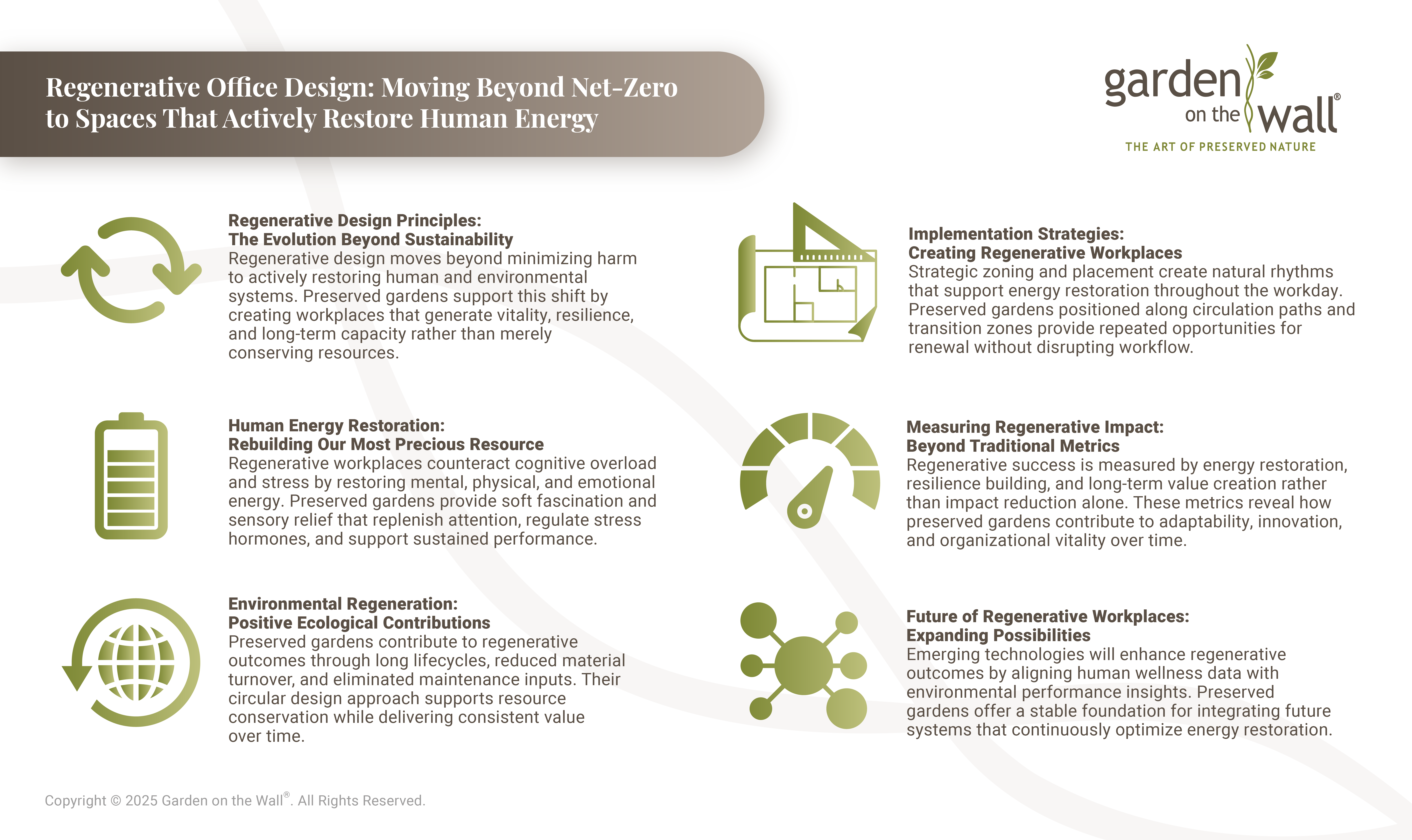
Implementation Strategies: Creating Regenerative Workplaces
Regenerative zoning approaches use preserved gardens, moss walls, planter inserts or draping preserved greenery to create distinct environments that support different energy restoration needs throughout the workday. High-intensity work areas benefit from preserved installations that provide stress relief and cognitive restoration, while collaboration zones can feature installations that encourage social interaction and creative thinking.
Energy flow optimization through strategic placement creates natural rhythms that support human circadian patterns and energy management. Garden on the Wall®'s preserved gardens, moss walls, and planter inserts positioned along circulation paths provide regular restoration opportunities while transition zones between work areas help employees shift mental states effectively.
Integration with renewable energy systems amplifies regenerative benefits as preserved nature elements support overall building performance without requiring energy-intensive maintenance systems. The passive nature of preserved installations aligns perfectly with renewable energy strategies while biophilic integration with other regenerative strategies creates synergistic benefits through Garden on the Wall®'s expertise across over 1,880 projects.
Measuring Regenerative Impact: Beyond Traditional Metrics
Regenerative design assessment requires metrics that capture positive value creation rather than simply measuring impact reduction. Energy generation indicates how preserved gardens, moss walls, and planter inserts actively restore human energy resources rather than simply reducing energy depletion, providing more accurate measures of regenerative effectiveness.
Ecosystem health indicators reveal how workplace design decisions contribute to broader environmental and social system health. Garden on the Wall®'s installations can be evaluated for their contributions to material flows, resource conservation, and social capital development that extend far beyond immediate building performance.
Resilience building metrics assess how regenerative environments strengthen capacity to adapt and thrive under changing conditions. Organizations in regenerative workplaces often show enhanced innovation capabilities, improved crisis response, and stronger collaborative relationships. Long-term value creation analysis examines cumulative benefits that emerge over extended timeframes as regenerative environments support continuous improvement in human and environmental health.
Future of Regenerative Workplaces: Expanding Possibilities
Technology integration opportunities will likely enhance regenerative design through smart systems that optimize human energy restoration while minimizing environmental impacts. IoT sensors could monitor both human wellness and environmental performance to create feedback loops that continuously improve regenerative effectiveness of preserved foliage elements.
Scaling regenerative principles across organizational networks could create regenerative business ecosystems where multiple workplaces support shared environmental and social health objectives. Research advancement continues revealing new mechanisms through which Garden on the Wall®'s installations contribute to regenerative outcomes, supporting increasingly sophisticated applications that maximize positive impacts.
Conclusion: The Future of Energy-Restoring Workplaces
The evolution toward regenerative office design represents more than an environmental imperative it's a strategic opportunity to create workplaces where human flourishing and environmental health mutually reinforce each other. Garden on the Wall®'s preserved nature offerings provide practical tools for implementing regenerative principles while delivering measurable benefits that support both immediate performance and long-term sustainability.
Regenerative design offers pathways to workplaces that actively contribute to human and environmental health rather than simply minimizing harm. As organizations recognize the competitive advantages of regenerative approaches, preserved installations will increasingly serve as foundational elements in offices designed to restore rather than deplete the energy systems that sustain both human and planetary health.
For more information on this subject, read this article: The Innovation Behind Premium Preserved Moss Installations: Advanced Preservation Technologies and Quality Control and other related information, please visit our website: www.gardenonthewall.com