Smart Biophilia: Integrating IoT Sensors with Preserved Nature Elements

Key Takeaways Before You Read the Full Article:
30 Second Executive Summary
Smart biophilia combines IoT sensors with preserved gardens and moss walls to create intelligent wellness environments that measure and optimize performance in real time. This integration transforms biophilic design from aesthetic enhancement into actionable, data-driven infrastructure.
🔬 Research Foundation: Measurable Wellness Optimization
Environmental and physiological data reveal how preserved nature elements reduce stress, improve focus, and enhance occupant satisfaction. Smart monitoring systems provide continuous feedback that validates and refines these benefits.
⚙️ Technology Advantage: Intelligent Infrastructure
Preserved installations provide stable, maintenance-free platforms for sensor integration and long-term data collection. IoT systems enhance these environments by enabling adaptive lighting, airflow, and space optimization.
📊 Business Impact: Data-Driven ROI
Organizations implementing smart biophilia gain measurable returns through productivity improvements, space utilization optimization, and wellness program validation. Real-time monitoring supports strategic decision-making in talent-driven workplaces.
🚀 Future Outlook: AI-Enhanced Biophilic Systems
Machine learning and predictive analytics will expand smart biophilia into fully adaptive wellness ecosystems. Intelligent integration positions preserved nature as foundational infrastructure for next-generation buildings.
Ready to see how preserved gardens become intelligent wellness platforms? The full article explores how smart biophilia redefines performance-driven workplace design.
Smart Biophilia: Integrating IoT Sensors with Preserved Nature Elements for Real-Time Wellness Monitoring
Imagine if your office walls could tell you exactly how they're improving your team's wellness in real-time. The convergence of biophilic design and smart building technology creates unprecedented opportunities to measure, optimize, and enhance wellness benefits of preserved foliage and moss walls. This data-driven approach transforms preserved nature elements into intelligent wellness platforms that continuously optimize human performance and environmental health through Garden on the Wall®'s innovative integration of traditional biophilic benefits with cutting-edge monitoring technology.
The Smart Building Evolution: Data Meets Nature
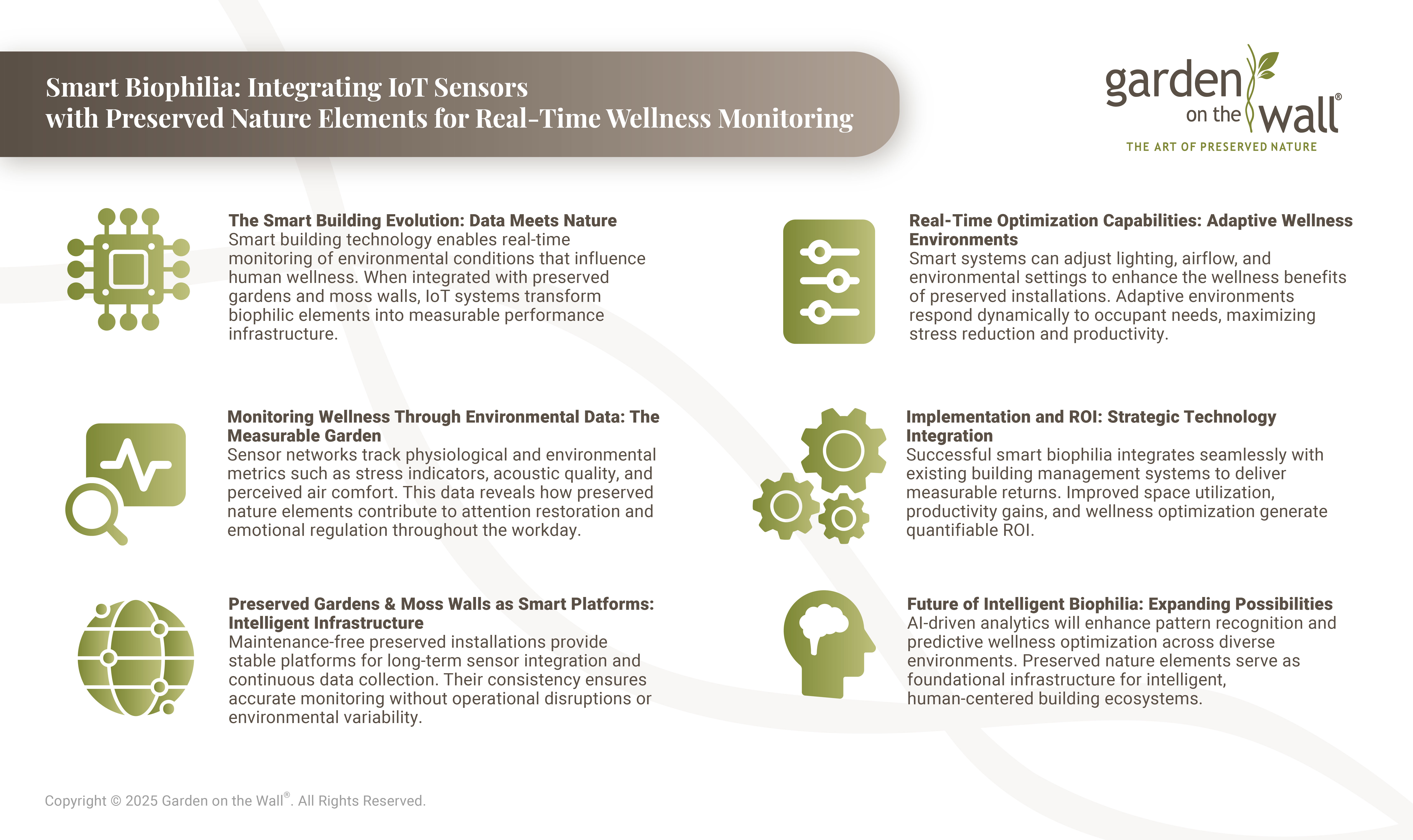
Smart building technology has revolutionized how we understand and optimize indoor environments, with IoT sensors providing real-time data on everything from air quality to space utilization. The integration of preserved gardens and moss walls with these systems represents the next frontier in workplace optimization, where biophilic elements become active participants in building intelligence rather than passive design features. Modern IoT networks can monitor dozens of environmental parameters simultaneously, and when integrated with preserved nature installations, these systems reveal previously invisible connections between natural elements and human wellness.
The data generated through smart biophilia applications provides facility managers and wellness professionals with actionable insights that go far beyond traditional environmental monitoring. Instead of simply tracking temperature and humidity, integrated systems can correlate preserved garden placement with stress reduction, productivity improvements, and overall occupant satisfaction. Garden on the Wall®'s maintenance-free installations provide ideal platforms for sensor integration, as their consistent performance and extended 10-12 year lifespan with potential 20+ year extension eliminates variables that could compromise data accuracy while ensuring long-term monitoring capabilities.
Monitoring Wellness Through Environmental Data: The Measurable Garden
Advanced sensor networks enable comprehensive wellness monitoring that reveals the specific mechanisms through which preserved foliage and moss walls improve human health and performance. Heart rate variability sensors positioned near preserved installations can demonstrate real-time stress reduction as individuals interact with biophilic elements, while physiological monitoring through wearable devices integrated with building systems provides unprecedented insights into how preserved nature elements affect occupant wellness throughout the day, tracking cortisol level changes, sleep quality improvements, and immune function markers.
Air quality monitoring takes on new dimensions when integrated with preserved gardens and moss walls, as sensors can measure not just pollutant levels but also the subtle atmospheric changes that contribute to the "fresh air" feeling often reported in spaces with natural elements. While preserved installations don't actively purify air like living plants, they contribute to perceived air quality through psychological mechanisms that affect breathing patterns and stress responses. Acoustic monitoring reveals how preserved nature elements contribute to sound management in complex workplace environments, with smart sensors measuring not just noise reduction but also the quality of acoustic environments, tracking how natural sound absorption contributes to improved concentration and reduced auditory stress.
Preserved Gardens & Moss Walls as Smart Platforms: Intelligent Infrastructure
The maintenance-free nature of preserved foliage makes these installations ideal platforms for long-term sensor integration and data collection. Unlike living plant systems that require frequent access for care activities, Garden on the Wall®'s preserved installations provide stable platforms for continuous monitoring without operational disruption. Sensor integration opportunities within preserved gardens and moss walls include environmental monitoring devices that track temperature, humidity, and air movement patterns around installations, revealing microclimatic effects that contribute to comfort and wellness while informing optimization strategies.
The longevity of preserved nature elements provides unprecedented opportunities for longitudinal health data collection, enabling researchers and facility managers to track long-term wellness trends and cumulative health benefits that emerge over months and years of exposure. Customizable monitoring parameters allow organizations to focus on specific wellness metrics that align with their particular objectives, whether tracking stress reduction in high-pressure environments, monitoring attention restoration in creative spaces, or measuring social interaction patterns around preserved installations. Power efficiency considerations favor preserved garden sensor integration, as these installations don't require electrical infrastructure for maintenance systems, allowing sensor networks to operate on low-power wireless systems.
Real-Time Optimization Capabilities: Adaptive Wellness Environments
Smart biophilia systems enable real-time environmental adjustments that optimize the wellness benefits of preserved gardens and moss walls based on current conditions and occupant needs. Adaptive lighting systems can respond to wellness data by adjusting illumination to enhance the visual impact of preserved installations during high-stress periods, while automated environmental controls create optimal conditions for biophilic wellness by adjusting temperature, airflow, and lighting to maximize stress-reduction benefits. Garden on the Wall®'s chemically safe and award-winning installations provide consistent baseline benefits that smart systems can enhance through environmental optimization.
Space utilization optimization becomes possible as smart systems identify which preserved nature element locations provide maximum wellness benefits under different conditions, informing real-time space allocation recommendations that direct occupants toward optimal wellness environments when needed most. Personalized environmental preferences can be accommodated through smart systems that learn individual responses to preserved foliage and adjust environmental conditions accordingly, with some individuals benefiting from brighter lighting that highlights preserved garden textures while others prefer softer illumination that creates more calming effects.
Implementation and ROI: Strategic Technology Integration
Successful smart biophilia implementation requires careful consideration of technology partnerships that align with existing building management systems while adding preserved garden-specific capabilities. The most effective approaches integrate seamlessly with current IoT infrastructure rather than requiring separate monitoring platforms, leveraging Garden on the Wall®'s expertise across over 1,880 projects to ensure optimal sensor placement and system integration. Cost-benefit analysis reveals that smart biophilia systems often provide rapid returns through improved space utilization, reduced wellness program costs, and enhanced productivity metrics.
Privacy and security considerations become crucial when implementing wellness monitoring systems, with successful smart biophilia approaches focusing on aggregate wellness trends rather than individual surveillance, providing organizational insights while protecting personal privacy rights. Change management strategies help organizations transition to data-driven wellness optimization by demonstrating how smart biophilia systems enhance rather than replace human judgment in creating supportive environments, with employee education about system benefits and privacy protections building acceptance and engagement.
Future of Intelligent Biophilia: Expanding Possibilities
Artificial intelligence integration will likely enhance smart biophilia systems through machine learning algorithms that identify complex patterns in how preserved gardens and moss walls affect wellness across diverse populations and conditions. These AI systems could provide increasingly sophisticated optimization recommendations while Garden on the Wall®'s Red List Free certification and comprehensive testing ensure that technological enhancements maintain the highest safety and environmental standards. Expanded sensor capabilities may include biometric monitoring through environmental sensors that detect stress indicators without requiring wearable devices.
Integration with broader smart city initiatives could position preserved nature elements as components in community-wide wellness optimization systems that share data and best practices across multiple buildings and organizations. The convergence of preserved foliage with smart building technology represents a fundamental evolution in creating and managing wellness-supporting environments, transforming beautiful biophilic installations into intelligent wellness platforms that optimize human performance while building evidence-based cases for continued wellness investments supporting both individual flourishing and organizational success.
For more information on this subject, read this article: The Future of Workplace Analytics: Measuring Productivity Gains from Biophilic Design Investments and other related information, please visit our website: www.gardenonthewall.com