
When Generations Collide: Bridging Age Gaps Through Universal Nature Connection

Key Takeaways Before You Read the Full Article:
30 Second Executive Summary
Today's workplaces bring together generations with different communication styles, expectations, technologies, and approaches to work. Biophilic design provides shared environmental experiences that can create common ground, support informal interaction, and help multigenerational teams connect without designing around the preferences of any single age group.
🌐 Universal Connection: Nature Creates Common Ground
Generational preferences change, but humans across age groups share an underlying connection to natural environments. Preserved gardens and moss walls provide a common environmental language that can make workplaces feel welcoming across generations.
🤝 Shared Spaces: Encouraging Organic Interaction
Neutral gathering environments create opportunities for employees who might not otherwise interact to connect naturally. Biophilic lounges, break areas, and collaboration zones can support informal conversations without forcing structured intergenerational programming.
💬 Communication: Supporting Different Ways of Working Together
Employees may prefer different combinations of privacy, openness, formal meetings, and spontaneous conversation. Flexible biophilic environments help accommodate these differences while maintaining visual and social connection.
🔄 Knowledge Exchange: Connecting Experience With New Perspectives
Multigenerational organizations benefit when institutional knowledge can move between experienced employees and emerging talent. Thoughtfully designed mentoring and collaboration spaces can make those exchanges feel more natural and less hierarchical.
🏢 Long-Term Workplace Strategy: Designing Beyond Generational Trends
Technology, workplace expectations, and workforce demographics will continue changing. Nature-centered environments provide an enduring foundation that can support evolving generations without requiring the workplace to be redesigned around every new trend.
Ready to explore how workplace design can turn generational differences into opportunities for connection? The full article examines how preserved gardens, moss walls, and flexible biophilic environments can support communication, mentorship, stress reduction, and collaboration across generations.
Modern Workplace Generational Collision
The modern workplace has become a fascinating collision of generational perspectives. Baby Boomers who value hierarchy and formal processes work alongside Generation Z employees who expect flat organizational structures and instant digital communication. Millennials seek purpose-driven work while Generation X prioritizes work-life balance. These differences create productive tensions, but they also generate misunderstandings, communication breakdowns, and workplace friction that can undermine team cohesion and organizational effectiveness.
Traditional approaches to bridging generational divides focus on training programs, mentorship initiatives, and policy adjustments. While valuable, these solutions often feel forced or artificial. There's a more fundamental approach that taps into something all generations share - an innate connection to nature that transcends age, technology preferences, and communication styles. Biophilic design offers unique solution to intergenerational workplace challenges by creating common ground that speaks to universal human experiences rather than generational preferences, fostering collaboration through environmental elements that appeal to shared evolutionary psychology.
The Universal Language of Nature
Despite their different relationships with technology, social media, and work styles, all generations share evolutionary connections to natural environments. Baby Boomers who grew up with more outdoor play, Generation X who experienced the environmental movement's emergence, Millennials who developed sustainability consciousness, and Generation Z who face climate anxiety - each group has distinct but genuine relationships with nature that create opportunities for connection.
Preserved gardens and moss walls tap into these universal connections without favoring any particular generational aesthetic. Unlike technology-based solutions that might intimidate older employees or traditional design elements that might seem outdated to younger workers, biophilic installations speak a language that everyone understands instinctively. Research in environmental psychology shows that nature exposure reduces cortisol levels and increases cooperative behaviors across demographic groups, creating shared positive associations that serve as foundation for improved intergenerational relationships and workplace harmony.
Creating Neutral Gathering Spaces
Generational tensions often emerge around technology use, communication preferences, and work style differences. Younger employees might prefer open collaboration and digital communication, while older workers value privacy and face-to-face interaction. These preferences can create spatial conflicts within workplace design that exacerbate rather than resolve generational misunderstandings and workplace friction.
Preserved nature installations offer solutions that appeal to both ends of the generational spectrum. Moss walls and preserved gardens create visual privacy without complete isolation, satisfying older employees' need for boundaries while maintaining the openness that younger workers prefer. Break areas enhanced with preserved foliage installations become natural gathering points where generational mixing occurs organically, creating neutral territory where conversations can develop naturally across age groups.
No-upkeep vertical green walls provide consistent environmental quality that supports intergenerational collaboration without maintenance disruptions that could affect different generational preferences for workspace stability. Wall plant art installations create focal points that provide conversation starters while supporting diverse aesthetic preferences across generational groups.
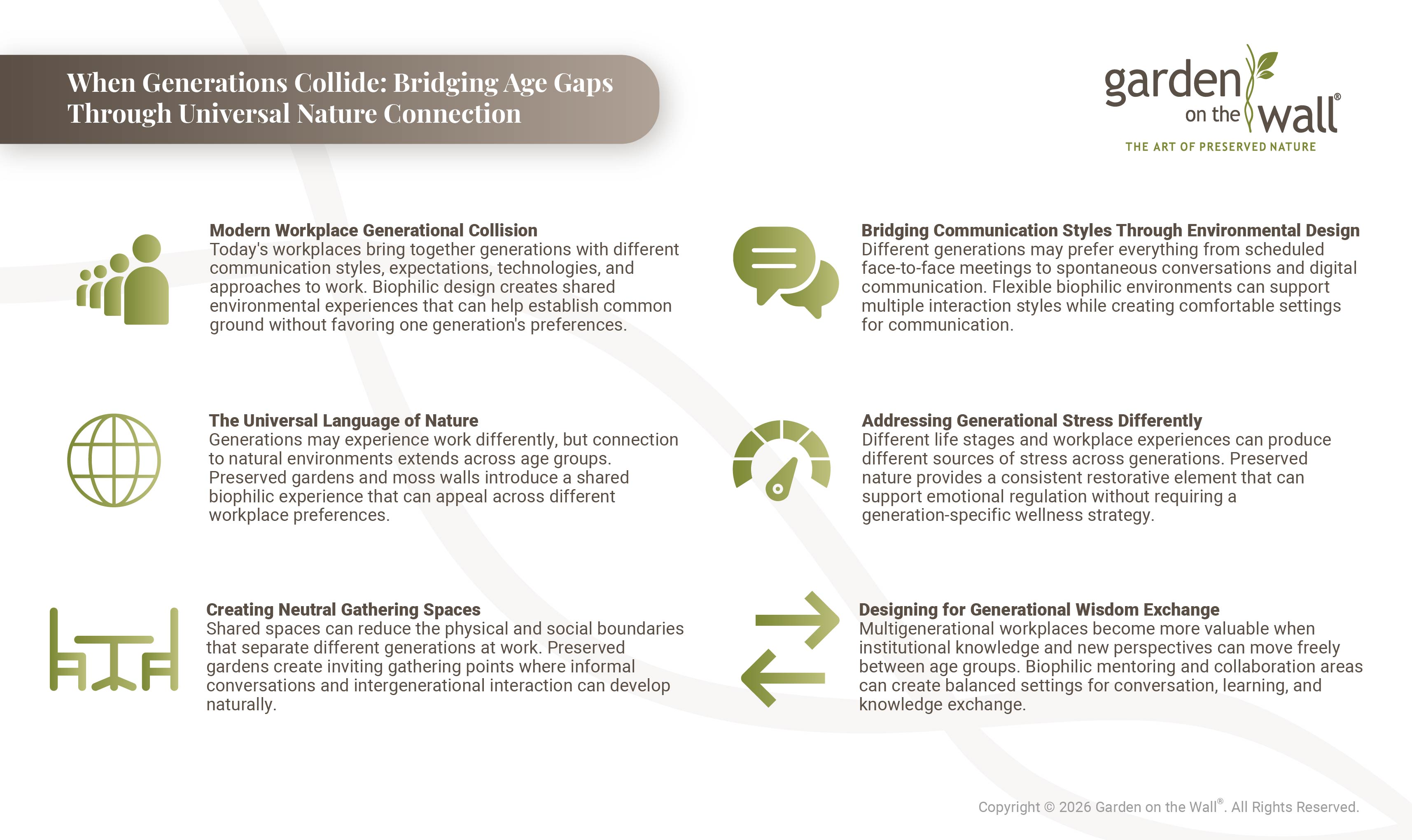
Bridging Communication Styles Through Environmental Design
Different generations prefer different communication approaches - from formal emails to instant messaging, from scheduled meetings to spontaneous conversations. These preferences can create barriers when team members can't find common communication ground, leading to misunderstandings and reduced collaboration effectiveness across age groups within organizations.
Biophilic design creates environments that support multiple communication styles simultaneously. Preserved garden installations in open areas provide backdrop for informal conversations that younger employees prefer while offering visual interest that makes older employees comfortable during longer discussions. Draping preserved foliage can create semi-private zones within open offices, allowing for generational preferences around workspace privacy while maintaining visual connections that support spontaneous collaboration.
Planter inserts enable flexible workspace configuration that adapts to different generational communication needs while providing consistent biophilic benefits that support stress reduction and improved interpersonal relationships across age groups. These installations create environments where different communication styles can coexist effectively.
Addressing Generational Stress Differently
Each generation faces distinct workplace stressors. Baby Boomers might struggle with technological changes, Generation X deals with sandwich generation pressures, Millennials face economic uncertainty, and Generation Z experiences climate anxiety and social media overwhelm. These different stress sources can create mutual incomprehension and workplace tension that affects team performance and organizational culture.
Preserved moss walls and garden installations provide stress relief that addresses multiple generational needs simultaneously. The visual calm supports older employees who might feel overwhelmed by technological pace while offering the authentic environmental connection that younger employees value for stress management. Garden on the Wall® demonstrates sustainability leadership through circular-economy commitment and take-back programs that resonate with environmentally conscious younger generations while providing the reliability and longevity that appeals to older employees' preferences for stable, dependable solutions.
Vertical green walls create calming environments that support emotional regulation across generational stress patterns while providing consistent environmental quality that doesn't require adaptation to changing maintenance schedules or seasonal variations that could affect different generational preferences for workplace predictability.
Designing for Generational Wisdom Exchange
The most successful intergenerational workplaces facilitate knowledge transfer between age groups. Older employees possess institutional memory and practical wisdom, while younger workers bring fresh perspectives and technological fluency. Creating environments that encourage this exchange requires careful spatial design that honors both traditional mentoring relationships and contemporary collaborative approaches.
Preserved garden and moss wall installations can define mentorship areas that feel comfortable for both mentors and mentees. Unlike formal meeting rooms that might feel intimidating or casual spaces that might seem unprofessional, biophilic environments create balanced settings that honor both traditional mentoring relationships and contemporary collaborative approaches. Planter inserts with preserved foliage offer flexible solutions that can be reconfigured to support different types of intergenerational interactions.
Draping foliage with preserved plants creates natural transitions between formal and informal spaces, supporting knowledge transfer activities while maintaining visual continuity that appeals to different generational aesthetic preferences. These installations provide environments where wisdom exchange occurs naturally rather than feeling forced or artificial.
Building Tomorrow's Multigenerational Workplaces
As workplaces continue evolving to accommodate increasingly diverse generational perspectives, biophilic design offers sustainable solutions that grow more valuable over time. Unlike technology-based interventions that quickly become outdated or design trends that fall out of favor, preserved nature installations provide enduring appeal that spans generational changes while supporting organizational continuity.
Commercial interior designers have the opportunity to create spaces that celebrate generational diversity rather than simply accommodating differences. Through strategic use of preserved gardens, moss walls, planter inserts, and preserved foliage installations, designers can create environments that bring out the best in every generation while fostering mutual respect and collaboration that drives organizational success.
The future belongs to workplaces that harness generational diversity as competitive advantage, and thoughtful biophilic design can transform these environments into laboratories for intergenerational innovation, learning, and growth. Wall gardens and preserved installations create lasting environmental infrastructure that supports evolving workforce demographics while maintaining aesthetic excellence and operational efficiency throughout organizational transitions and generational workforce changes.
For more information on this subject, read this article: Biophilia and Human Connection: Bringing People Together in Post Pandemic Workplaces and other related information, please visit our website: www.gardenonthewall.com.


