Biophilia and Human Connection: Bringing People Together in Post-Pandemic Workplaces

Key Takeaways Before You Read the Full Article:
30 Second Executive Summary
Post-pandemic workplace disconnection creates measurable business problems including reduced performance, elevated burnout, and billions in annual costs from loneliness-related stress. While remote work receives blame, the deeper issue reveals how commercial environments fail to support fundamental human connection needs.
🔬 Research Foundation: Studies covering 308,000+ participants demonstrate strong social relationships increase survival rates by 50% while workplace loneliness correlates with significantly lower job performance, reduced satisfaction, and elevated burnout.
💼 Business Impact: Companies lose $154 billion annually to loneliness-related costs while 69% of employees report dissatisfaction with workplace connection opportunities, creating retention challenges and innovation barriers.
🌱 Sustainability of Connection: Biophilic design provides evidence-based strategies for creating environments that naturally facilitate human connection through preserved nature elements, strategic spatial planning, and neurologically supportive features reducing stress barriers.
🎯 Specification Confidence: Connection-focused workplace design requires preserved moss walls and vertical gardens providing consistent nature experiences that support both individual restoration and group gathering while creating spaces where authentic relationships develop naturally.
Ready to restore human connection in commercial workplaces through strategic biophilic design? The complete article reveals comprehensive implementation strategies that support measurable business results.
THE POST-PANDEMIC CONNECTION PROBLEM
Workplace isolation has become one of the biggest challenges facing companies after pandemic disruptions. Research from Cigna's 2020 survey of over 10,000 U.S. adults found that 52% of Americans sometimes or always feel alone - up six percentage points from 2018. A detailed analysis in Occupational Medicine of 49 research articles found workplace loneliness strongly connects to lower job performance, reduced satisfaction, and elevated burnout.
The financial costs are massive. Boston University research shows $154 billion in annual costs from loneliness-related stress and employee absences. Yet many companies treat dis-connection as a personal problem rather than a company-wide challenge requiring environmental changes. This represents a failure to understand how physical workplaces either help or hurt people's need for meaningful connection.
WHY CONNECTION MATTERS TO HUMAN HEALTH
Humans evolved as highly social creatures whose survival depended on strong community bonds. This evolutionary history shows up in our brain structure - social isolation triggers stress responses identical to physical threats, starting inflammatory responses that weaken immune function and brain performance. A major analysis in PLOS Medicine examining 148 studies with over 308,000 participants found that people with stronger social relationships have a 50% better chance of survival compared to those with weaker connections.
Workplace relationships matter especially because work takes up over half of waking hours for most adults. Research published in PLOS ONE studying German employees during the first pandemic wave found that more than one-third got less social support at work than they wanted, directly connecting to higher mental health problems. The absence of meaningful workplace connection doesn't just reduce job satisfaction - it fundamentally harms human health and functioning.
HOW LONELINESS HURTS JOB PERFORMANCE
The Ozcelik and Barsade field study of 672 employees and 114 supervisors showed how loneliness undermines performance. Lonelier employees were less approachable, causing coworkers to share less information and provide fewer resources needed for good work. This created a harmful cycle - isolation led to reduced social skills, which increased isolation, further hurting social abilities. The research proved wrong the idea that "misery loves company," finding instead that grouping lonely people made things worse through combined social problems.
Gallup data tracking over 42,000 full-time U.S. workers from March 2020 through October 2021 found that nearly two in ten workers reported ongoing loneliness regardless of work location - remote, hybrid, or on-site. This challenges simple stories blaming workplace disconnection only on remote work. The problem existed before pandemic disruptions and continues across work types, showing that physical closeness alone isn't enough for meaningful connection.
THE HIDDEN COST TO COMPANY CULTURE
BetterUp's 2022 research of 3,000 U.S. workers showed that 69% felt dissatisfied with workplace connection opportunities, while 52% actively wanted more connection at work. Employees with low social connection showed anxiety and depression increases of 158%, burnout increases of 109%, and stress rises of 77% compared to well-connected peers. These numbers signal basic cultural problems that hurt how well companies work.
The American Survey Center's 2022 study of over 5,000 adults found that social connections at work explain nearly 30% of differences in job satisfaction while also reducing depression and improving job performance. When pandemic restrictions forced isolation, six in ten Americans lost touch with friends - many of whom were originally workplace connections. This massive disruption revealed how commercial environments had served as primary social infrastructure for millions of workers, a function that many companies had neither recognized nor intentionally supported through thoughtful design.

BIOPHILIC DESIGN AS CONNECTION INFRASTRUCTURE
Nature provides a universal language that works across different types of people while creating comfortable settings for spontaneous interaction. Preserved gardens, preserved planter inserts and moss walls offer special advantages for connection-focused workplace design because they combine visual interest that naturally draws people together with consistent beauty that doesn't create maintenance problems or decay periods that might discourage gathering. Research in neuroaesthetics shows that natural environments reduce social anxiety while promoting positive feelings - creating mental conditions better suited for real personal engagement, and collaboration.
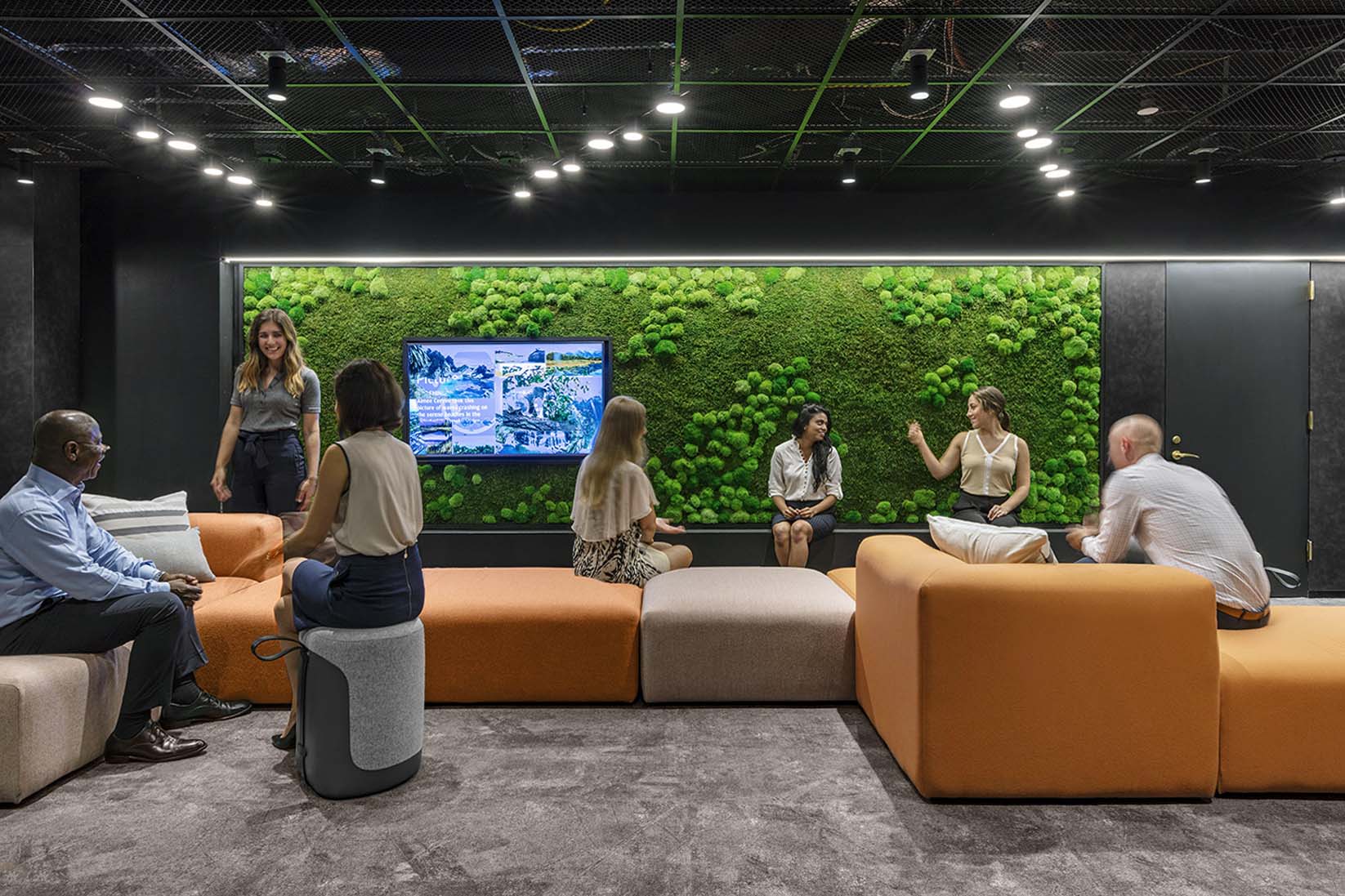
Smart placement of biophilic elements transforms underused transition spaces into attractive spots where colleagues naturally pause, creating opportunities for spontaneous conversation that builds relationships naturally. Garden on the Wall® installations in collaborative zones and informal gathering areas provide visually appealing focal points - micro experiences - that give people reasons to linger, supporting the brief but repeated interactions that research shows build workplace friendships and strengthen team unity.
CREATING ENVIRONMENTS THAT INVITE CONNECTION
Accenture's May 2022 research found that only one in six people felt highly connected at work in a human sense, with on-site workers feeling least connected despite physical closeness. This surprising finding emphasizes that connection needs more than just being in the same place - it requires thoughtfully designed environments supporting various interaction types. Companies achieving "omni-connected" experiences saw 7.4% annual revenue growth advantages while connection quality accounted for 59% of employee plans to stay.
Good connection-supporting design includes comfortable seating areas near preserved vertical gardens or planter inserts where employees can relax during breaks, creating natural opportunities for casual conversation. Biophilic elements in reception areas, elevator lobbies, and cafe spaces transform functional transitions into pleasant experiences that encourage presence rather than quick passage. These small interventions add up to big impacts on workplace culture by normalizing the brief daily exchanges that research shows form the foundation of workplace relationships.
BEYOND LOOKS: THE BRAIN SCIENCE OF SHARED NATURE
The Journal of Applied Ergonomics research in 2023 found that supportive environments reduce loneliness impacts on wellbeing more effectively than simply increasing task sharing or interaction opportunities. This shows that environmental quality - the mental tone set by physical surroundings - fundamentally influences whether social connection grows or dies. Biophilic design creates this supportive quality through multiple sensory channels that unconsciously signal safety, comfort, and welcome.
Preserved nature installations provide consistent visual softness and organic complexity that brain science research shows reduces stress while improving mental restoration. Importantly, preserved moss walls also provide acoustic dampening properties that reduce ambient noise levels - a critical consideration for neurodiverse employees who may experience heightened sensitivity to auditory stimulation. By reducing these sensory triggers, preserved gardens create environments where the estimated 15-20% of neurodivergent individuals (per HOK + Tarkett Study in 2022) in the workforce can engage more comfortably in social interaction without overwhelming sensory barriers.
When employees feel less stressed and mentally tired, they have greater capacity for positive social engagement. This means biophilic elements support connection not only by creating attractive gathering spaces but by improving the basic mental and emotional states that enable real relationship building throughout workdays.
HOW TO IMPLEMENT CONNECTION-CENTERED DESIGN
Companies addressing workplace dis-connection must move beyond surface interventions like occasional social events toward complete environmental strategies that naturally support connection as part of daily work. This requires careful analysis of existing space patterns - where do people naturally gather, where do they avoid, what environmental factors encourage staying versus quick passage. Preserved gardens and moss walls positioned strategically at these points can dramatically shift space dynamics by creating attractive destinations where people genuinely want to spend time.
Successful connection-focused design also recognizes different social preferences - providing options from intimate seating for two close to smaller preserved garden or planter insert installations to larger gathering spaces with substantial biophilic focal walls or large planter insert areas supporting comfortable group interaction. This variety honors that some employees build connection through quick daily check-ins while others prefer extended conversations, ensuring that environmental design supports various social styles rather than favoring extroverted patterns that alienate those with different connection preferences.
Meaningful human connection in the workplace represents valuable currency for companies focusing on their bottom line, making connection-focused design a strategic investment rather than an optional amenity. Biophilic design is an important tool in designers’ toolkit to offer this opportunity to their clients.
For more information on this subject, read this article: The Green Workplace & Office Design: Embracing Biophilia in Workspaces with Preserved Gardens, Moss Walls & Planter Inserts and other related information, please visit our website: www.gardenonthewall.com