
The Innovation Paradox: Why Constraint-Free Creativity Needs Structured Natural Elements

Key Takeaways Before You Read the Full Article:
30 Second Executive Summary
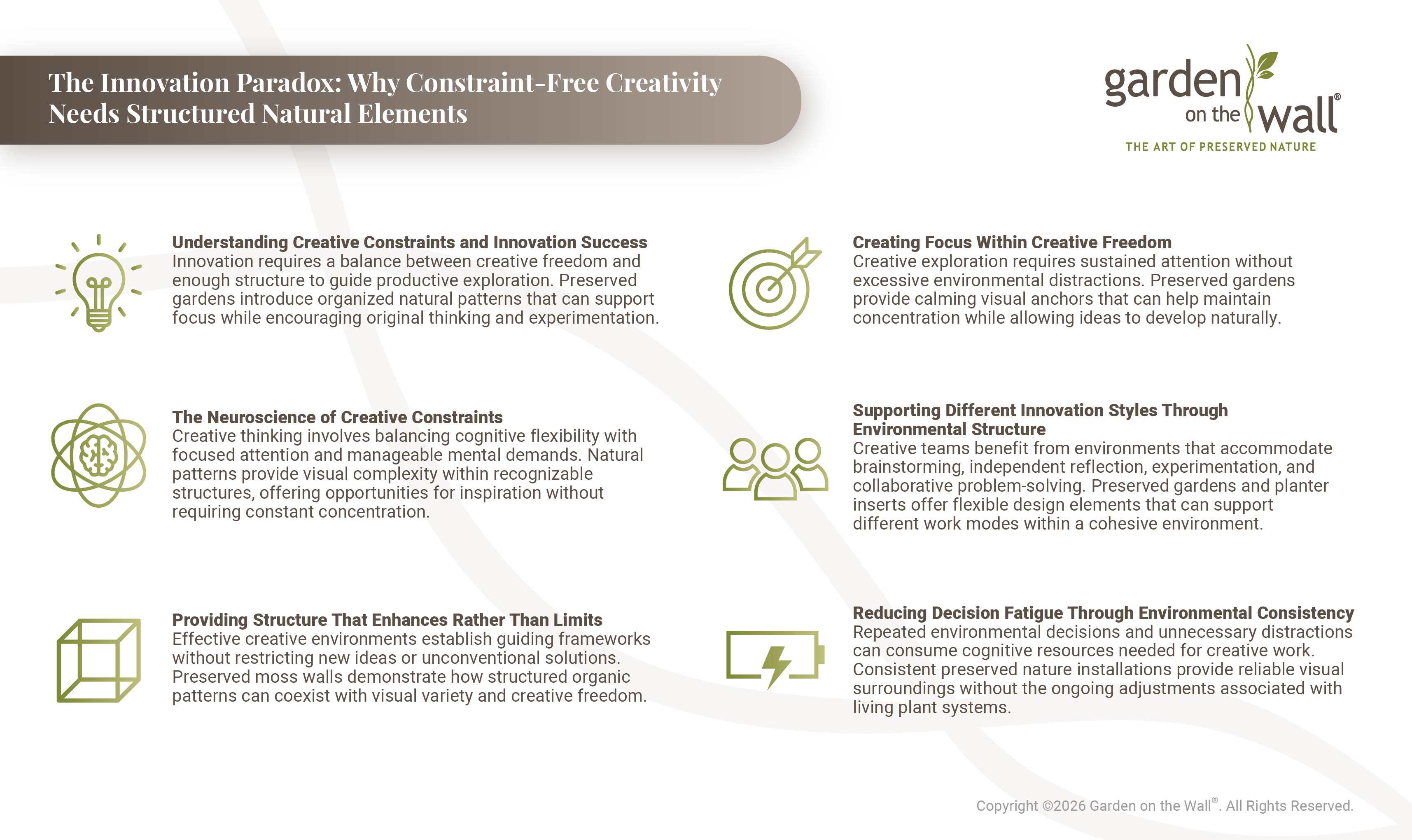
Innovation does not always flourish in environments offering unlimited freedom. Thoughtfully structured creative spaces use natural patterns, visual consistency, and flexible biophilic elements to balance focused attention with exploration, helping teams pursue new ideas without unnecessary cognitive demands.
💡 Innovation Strategy: Balancing Structure and Creative Freedom
Effective creative environments provide enough structure to guide exploration without limiting unconventional thinking. Preserved gardens introduce organized natural patterns that can support both inspiration and focused problem-solving.
🧠 Research Foundation: Understanding Creative Constraints
Creative work requires cognitive flexibility alongside sustained attention and manageable mental demands. Nature-inspired patterns offer a balance of visual complexity and organization that can complement different creative processes.
🎯 Focused Creativity: Supporting Productive Exploration
Excessive environmental stimulation can compete with the attention required for complex problem-solving. Preserved moss walls provide consistent visual elements that can help create calmer settings for creative concentration.
🤝 Collaborative Innovation: Accommodating Different Thinking Styles
Innovation teams benefit from environments that support independent reflection, rapid brainstorming, and collaborative refinement. Flexible biophilic installations can help define spaces for different activities without creating rigid separation.
⚙️ Long-Term Value: Reducing Environmental Decision Fatigue
Consistent surroundings can reduce unnecessary environmental demands while supporting sustained creative work. Maintenance-free preserved gardens offer lasting visual quality without requiring irrigation or routine plant care.
Ready to explore how structure can strengthen rather than restrict creativity? The full article examines how preserved gardens, moss walls, and nature-inspired design can help create innovation environments that balance freedom, focus, flexibility, and sustained creative performance.
Understanding Creative Constraints and Innovation Success
Creative constraint optimization represents a fundamental misunderstanding in innovative environment design, where conventional wisdom suggests that breakthrough thinking requires complete freedom from limitations, yet neuroscience research reveals that too much freedom can actually inhibit creative thinking by overwhelming decision-making systems and preventing the focused attention necessary for innovative breakthrough. The most effective innovative environments provide carefully designed constraints that channel rather than restrict creative energy through environmental parameters that offer enough structure to focus attention while maintaining sufficient flexibility for novel solution development. Complete creative freedom can trigger choice paralysis that prevents productive action, while excessive environmental constraints shut down innovative thinking entirely.
Neuroscience studies demonstrates that human creativity operates most effectively within optimal constraint conditions that balance openness with focusing elements, requiring environments that help direct creative energy toward productive exploration rather than endless possibility consideration. Natural systems provide perfect examples of this principle through structured patterns that generate rather than prevent creative diversity, such as trees growing within organized frameworks while achieving infinite variation, or ecosystems maintaining organized relationships that support rather than constrain biodiversity and adaptation.
Preserved moss walls and garden installations bring these natural organizational principles into commercial innovation environments by providing visual frameworks that suggest structure without imposing rigid limitations on creative exploration.
Human creativity operates most effectively within what researchers call "optimal constraint conditions" - environmental parameters that provide enough structure to focus attention while maintaining sufficient flexibility for novel solutions. Complete freedom can trigger choice paralysis that prevents creative action, while excessive constraints can shut down innovative thinking entirely. Preserved gardens, moss walls, and vertical green walls provide ideal creative constraints by offering rich visual complexity within organized natural patterns.
The Neuroscience of Creative Constraints
Human creativity operates most effectively within optimal constraint conditions that provide environmental structure without imposing artificial limitations on thinking processes. Complete freedom can trigger choice paralysis that prevents creative action, while excessive constraints shut down innovative thinking entirely. The most effective creative environments balance openness with elements that help focus creative energy while maintaining flexibility for breakthrough solutions.
Preserved moss walls and garden installations provide ideal creative constraints by offering rich visual complexity within organized natural patterns. The organic structures provide enough environmental organization to focus attention without imposing artificial limitations on thinking. The natural frameworks suggest possibilities rather than dictating solutions, creating environmental conditions that channel creative energy toward productive exploration while maintaining flexibility necessary for innovative breakthrough.
No-upkeep green walls ensure that creative constraint benefits remain consistently available without maintenance disruptions that could affect innovation workflows or interrupt creative processes during crucial breakthrough periods. Garden on the Wall® provides complete system integration and professional coordination that ensures innovative environments achieve optimal constraint conditions without operational complications.
Providing Structure That Enhances Rather Than Limits
Effective creative constraints enhance rather than restrict innovative potential by providing frameworks that guide without controlling creative exploration. Natural systems offer perfect examples of this principle - trees grow within structured patterns yet achieve infinite variation, while ecosystems maintain organized relationships that support rather than constrain biodiversity and creative adaptation.
Preserved garden installations bring these natural organizational principles into environments for innovation by providing visual frameworks that suggest structure without imposing rigid limitations. Organic patterns offer environmental examples of how constraints can generate rather than prevent creative diversity. Teams working near preserved moss walls often report increased focus and creative confidence as natural structures provide psychological anchoring.
Wall plant art installations create focal points that support sustained creative attention while offering rich visual material for metaphorical thinking and analogical reasoning that often drives innovative insight. Moss art installations provide environmental examples of creative complexity achieved through organized natural systems.
Creating Focus Within Creative Freedom
Innovation requires sustained attention on specific problems or opportunities, yet completely open environments can scatter attention across unlimited possibilities. Effective creative spaces must balance openness with elements that help focus creative energy on productive exploration rather than endless possibility consideration while maintaining cognitive resources for breakthrough thinking.
Preserved nature installations provide attention-focusing elements that work with rather than against creative freedom. Organic complexity offers rich material for contemplative focus during creative thinking without overwhelming cognitive resources needed for problem-solving. Visual consistency helps maintain sustained attention on creative challenges while natural beauty provides inspiration and emotional support.
Planter inserts with preserved foliage offer flexible solutions that can be adjusted based on specific innovation requirements while providing consistent environmental support for focused creative work. Draping preserved foliage creates semi-private spaces for individual innovation work while maintaining visual connection to collaborative team environments.
Supporting Different Innovation Styles Through Environmental Structure
Innovation teams include individuals with varying creative styles and cognitive preferences. Some innovators work best with high stimulation and rapid idea generation, while others require quiet reflection and gradual insight development. Some prefer collaborative brainstorming while others need individual contemplation before sharing ideas. Effective innovation environments must accommodate these diverse creative approaches.
Natural elements provide environmental support for diverse innovation styles because they offer both stimulating complexity and calming simplicity depending on attention focus and interaction approach. Preserved moss walls can provide visual stimulation for rapid ideation while offering calming backgrounds for reflective thinking. The organic patterns support both divergent exploration and convergent refinement throughout innovation cycles.
Vertical green walls create shared focal points that support collaborative innovation activities while providing individual inspiration for creative reflection. The consistent presence helps establish productive creative rhythms by providing reliable environmental cues for different types of creative work throughout innovation processes.
Reducing Decision Fatigue Through Environmental Consistency
Creative work involves countless micro-decisions about direction, focus, and approach that can gradually deplete cognitive resources needed for innovative thinking. Environments that demand constant decision-making about space configuration, tool access, or environmental comfort can interfere with mental energy available for creative problem-solving while compromising innovation effectiveness.
Preserved nature installations reduce environmental decision fatigue by providing consistent, optimized conditions for creative work without requiring ongoing attention or adjustment. The maintenance-free operation ensures that environmental support for innovation remains available without creating additional cognitive load or resource allocation decisions that can detract from primary creative objectives.
Environmental consistency allows teams to develop deep associative relationships with specific visual elements, creating memory networks that can trigger creative insights during future innovation sessions. This environmental stability supports rather than compromises creative flexibility by eliminating operational uncertainty that could interfere with innovative focus.
Future of Structured Creative Environments
Successful integration of innovation-supporting biophilic elements requires understanding specific types of creative work and innovation challenges characteristic of different organizational contexts. Research and development environments need installations that support extended contemplative work, while rapid prototyping spaces require solutions that maintain energy during intensive collaborative sessions.
As organizations recognize that effective innovation requires strategic environmental design rather than simply unlimited freedom, spaces that provide productive creative constraints become increasingly valuable for competitive advantage and breakthrough thinking. Commercial interior designers have opportunities to create innovative environments that channel rather than restrict creative potential through thoughtful environmental structure.
Through strategic integration of preserved gardens, moss walls, planter inserts, and draping preserved foliage, designers can create spaces that support focused creative work necessary for sustained innovation while providing flexibility and inspiration that breakthrough thinking requires.
For more information on this subject, read this article: Creative Courage Designing Environments That Unlock Bold Innovation Through Biophilic Elements and other related information, please visit our website: www.gardenonthewall.com.


