Evidence-Based Design: Restorative Nature for Clinical Outcomes
Healthcare design operates under constraints that no other commercial interior sector faces. Material specification decisions must satisfy infection control protocols, fire safety standards, patient and staff psychology, regulatory compliance, and - increasingly - federal reimbursement metrics tied directly to patient experience. The clinical environment is no longer incidental to health outcomes. It is a care delivery tool.
Garden on the Wall® is the biophilic specification choice trusted by Mayo Clinic, Memorial Sloan Kettering, New York-Presbyterian, and leading healthcare interior design firms nationwide. For environments where compromise is a liability, preserved nature delivers what no live wall and no faux alternative can: verified material safety, natural fire compliance, zero infection vector, and measurable patient outcomes - backed by third-party testing.

The Only Choice: Why Specification Matters Here
In high-acuity clinical environments - hospital corridors, oncology suites, pediatric units, ICUs - the specification of biophilic elements is not an amenity decision. It is a clinical and compliance decision. Two alternative categories cannot meet this standard.
Living plants and live green walls are restricted and limited in clinical areas due to the documented infection risk of soil-borne pathogens, mold colonization in irrigation systems, and pest introduction. The irrigation and drainage infrastructure required introduces water damage risk incompatible with sterile environments.
Faux plants present a distinct risk profile: petrochemical compounds (PVC, polyethylene) that can off-gas VOCs, carry no documented material health transparency, and - critically - many are treated with chemical fire retardants that introduce additional off-gassing concern in environments where sensitive patient populations cannot be exposed to unknown chemical loads. The brain also distinguishes synthetic from authentic nature, meaning the neurological restorative benefit of biophilia does not transfer to faux products.


The Specification Moat
Garden on the Wall® is the only biophilic system verified for sterile-adjacent environments with all of the following:
Zero water, soil, or irrigation - eliminates mold, pathogen, and pest risk at the source.
ASTM E84 Class 1/A Fire Rating - naturally achieved, no chemical flame retardant treatment.
Red List Free (Declare Label) - no Living Future Institute Red List chemicals.
HPD v2.3 at 100 ppm full ingredient disclosure - complete chemical transparency for procurement.
CDPH Section 01350 VOC Compliance - verified low emission for occupied clinical spaces.
Published EPD (ISO 14025) - the only one in the preserved garden category worldwide.
7-Year Warranty - longest performance guarantee in the category.
20+ year product lifecycle - no replacement cycles disrupting patient care environments.

The Clinical Mandate: Designing for the 2030 Horizon
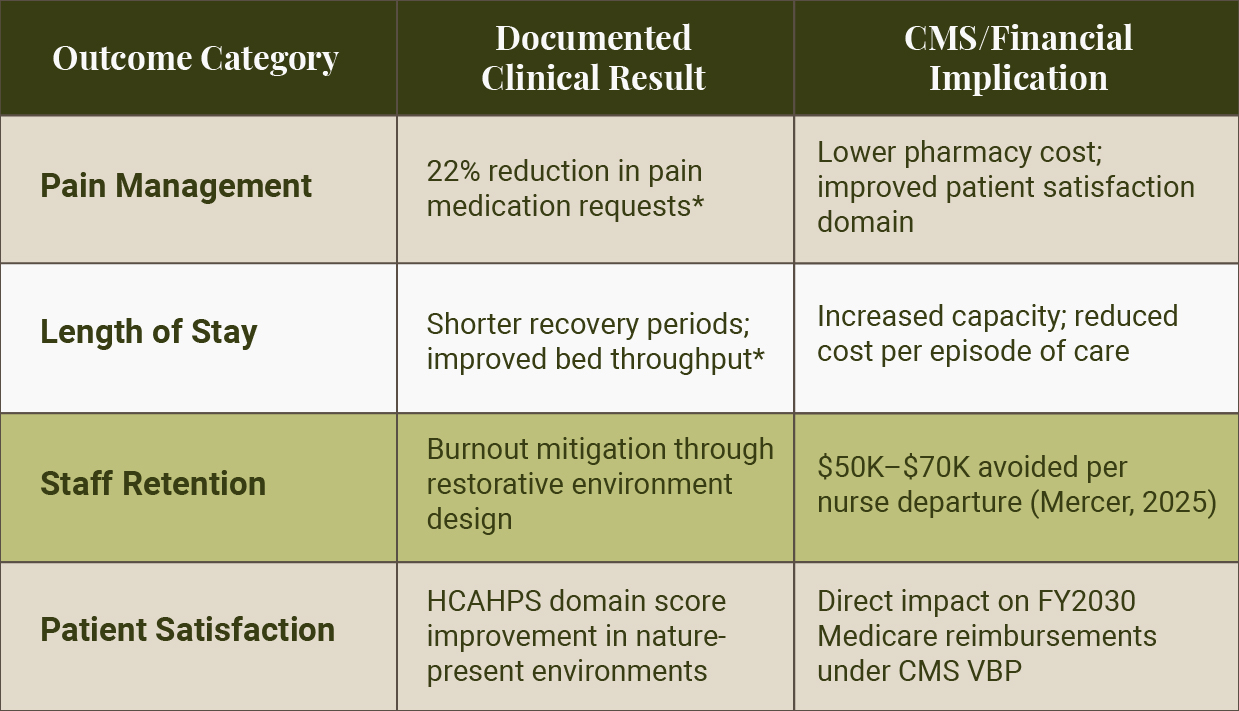
The Centers for Medicare & Medicaid Services (CMS) Value-Based Purchasing program ties a percentage of Medicare base payments directly to patient experience metrics measured by the Hospital Consumer Assessment of Healthcare Providers and Systems (HCAHPS). Beginning FY 2030, this performance-based reimbursement structure intensifies the financial stakes of the patient environment.
Evidence-based design (EBD) research - spanning more than 160 years of documented study - demonstrates that nature exposure directly influences the biology of recovery through autonomic nervous system regulation, cortisol reduction, and attention restoration. The clinical outcomes are measurable, peer-reviewed, and directly linked to the metrics CMS track.
Explore the Research and learn how evidence-based biophilic design supports caregiver well-being, patient recovery, operational efficiency, and healthcare workforce resilience in The Restorative Mandate Executive Summary.