The Future of Commercial Real Estate: Why Connection Outweighs Capacity
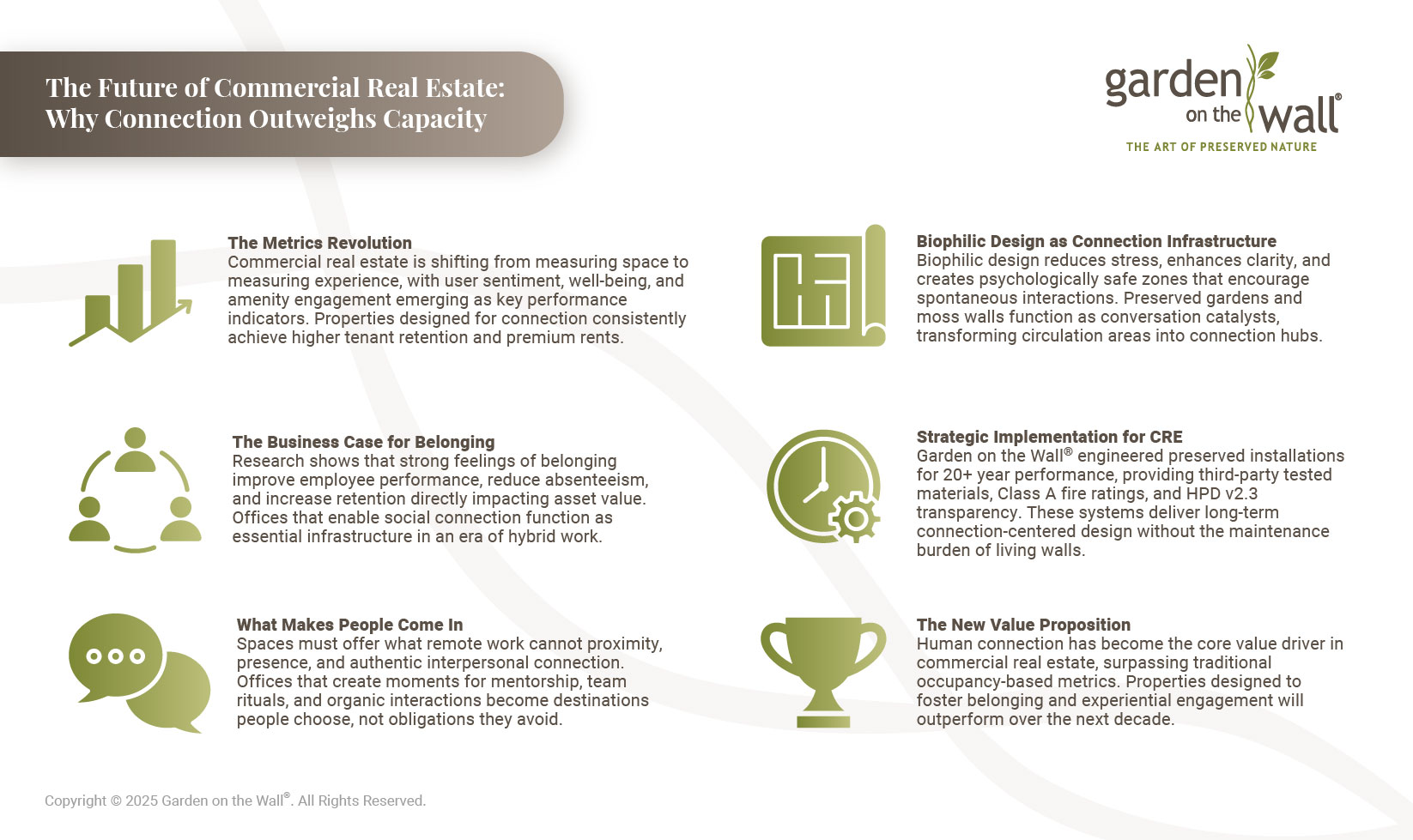
Key Takeaways Before You Read the Full Article:
30 Second Executive Summary
Diane Hoskins, Global Co-Chair at Gensler (the world's #1 design firm), reveals CRE's fundamental transformation where human connection outweighs traditional capacity metrics, demonstrating that asset value now depends on fostering belonging rather than maximizing occupancy rates.
💼 Business Impact: New Valuation Metrics CRE professionals must shift from "How full is the building?" to "How well does it work for those inside?" Properties integrating wellness and connection infrastructure command premium rents with superior tenant retention.
🔬 Research Foundation: Belonging Drives Bottom Line MIT research shows employees with strong belonging perform 56% better and take 75% fewer sick days. Gensler's 2025 survey reveals 65% feel most connected to company culture in physical offices proving connection represents financially material metrics.
🎯 Strategic Implementation: Biophilic Connection Infrastructure Preserved moss walls and vertical green walls create conversation infrastructure supporting spontaneous interaction and psychological safety essential for thriving workplaces.
📊 Performance Metrics: Experience Economy Success Properties designed for belonging and informal collisions consistently outperform in experience ratings, positioning connection-centered assets for sustained success.
Ready to implement connection-centered design aligned with the metrics revolution Hoskins describes? The complete article reveals how biophilic installations transform properties into spaces where human connection thrives.
Commercial real estate professionals face a fundamental question that extends far beyond traditional performance metrics. Diane Hoskins, FAIA, NCARB, Global Co-Chair at Gensler and co-author of "Design for a Radically Changing World," has articulated this transformation in her recent article "The Future of Real Estate Metrics: Human Connection."
As the leader of the world's top-ranked architecture and design firm, Hoskins provides essential insights for CRE professionals navigating an industry at an inflection point. Her analysis reveals that the most valuable commercial assets in coming years will be those designed specifically to foster human connection, belonging, and meaningful relationships rather than simply maximizing occupancy rates.
The Metrics Revolution: From Square Footage to Social Capital
Hoskins identifies a profound shift in how the industry must evaluate asset performance. Traditional benchmarks - "square footage, location quality, occupancy rates, and revenue per square foot" - remain relevant but no longer tell the complete story. As she notes in her article, "Today, real estate is shifting from static assets to dynamic settings for experience." The fundamental question has evolved from "How full is the building?" to "How well is it working for those inside?"
This evolution introduces entirely new performance indicators that CRE professionals must understand and implement. As Hoskins identifies, "user sentiment, amenity engagement, optionality, and tenant well-being" now provide tangible measures of success that directly impact asset valuation. Properties that integrate wellness, hospitality, and technology consistently command premium rents and demonstrate stronger tenant retention - creating measurable financial advantages for owners who recognize this paradigm shift.
The Business Case for Belonging: Research That Changes Everything
Hoskins presents compelling research demonstrating that belonging represents far more than abstract workplace satisfaction. Gensler's 2025 Global Workplace Survey reveals that 65% of employees feel most connected to their company's culture in the office environment, while 82% report experiencing strong belonging with colleagues in physical workplace settings. These aren't merely feel-good statistics - they're predictive indicators of organizational performance and asset value.
The financial implications become unmistakable when examining MIT Sloan research that Hoskins highlights: employees experiencing strong workplace belonging demonstrate 56% performance improvements, 75% reductions in sick leave, and 50% lower turnover rates - metrics that translate directly to measurable ROI for organizations investing in connection-centered environments. As she emphasizes, "Belonging isn't a soft metric - it goes straight to the bottom line." For CRE professionals, this research fundamentally alters investment decisions by establishing human connection as financial material rather than peripheral.
Stanford University's research further validates the office's critical social role, finding that "meeting through or as coworkers" remains a primary way adults form meaningful relationships after college. This positions commercial real estate not as mere workspace but as essential social infrastructure that organizations cannot replicate through remote work arrangements.
What Makes People Want to Come In: The Experience Economy
Hoskins argues that organizations have moved beyond asking "Should we return?" to confronting a more strategic question: "What makes people want to come in?" In an era defined by flexibility and personal choice, physical space must justify its value proposition by delivering what remote arrangements fundamentally cannot replicate; face-to-face proximity, embodied presence, and the authentic human connection that research demonstrates as essential for organizational performance and individual wellbeing.
The answer lies in spaces designed specifically for connection. As Hoskins observes, offices that prioritize mentorship opportunities, "informal collisions," "team rituals," and "shared moments"consistently outperform in experience ratings. People choose to work in environments where they feel they belong to something meaningful. This shifts the entire value proposition for commercial real estate from transactional space rental to experiential environment creation.
Hoskins extends this observation beyond corporate workplaces to entire urban environments. Gensler's 2025 City Pulse Survey - drawing insights from more than 33,000 residents in 65 cities worldwide - found that while people relocate for jobs and infrastructure, they remain in cities because of emotional connection. Local pride, cultural resonance, and authentic sense of community consistently emerge as primary reasons residents choose to stay - suggesting that emotional connection stabilizes both populations and economies far more effectively than amenities alone.
Click here to watch our video on "Human Connection in Commerical Real Estate"
Biophilic Design as Human Connection Infrastructure
The connection imperative that Hoskins articulates requires specific environmental strategies that support spontaneous interaction, psychological safety, and authentic relationship building. Biophilic design principles provide proven mechanisms for creating these conditions through strategic integration of natural elements that reduce stress, enhance cognitive function, and establish psychological comfort essential for meaningful human interaction.
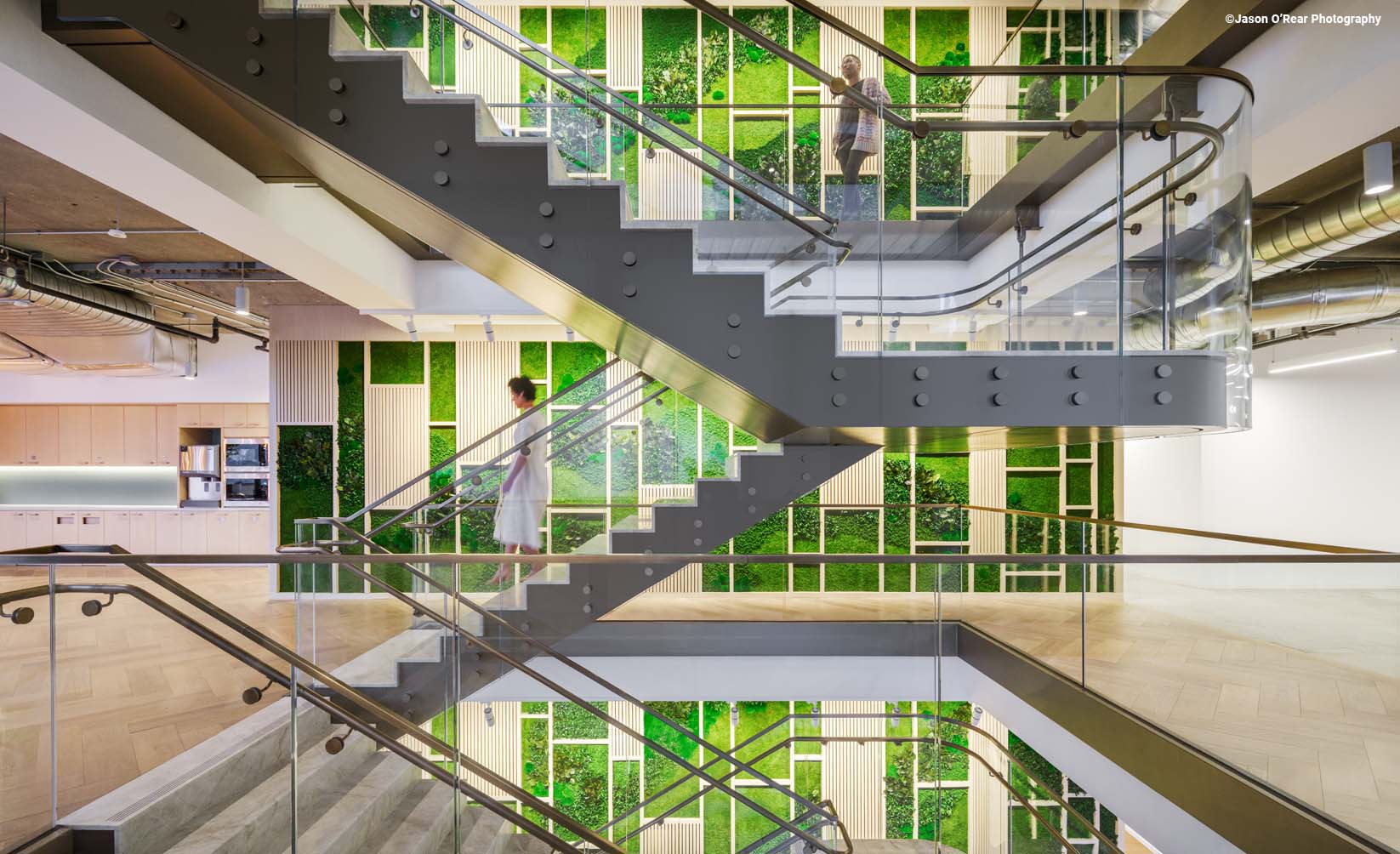
Research in neuroaesthetics demonstrates that exposure to natural elements triggers measurable physiological responses including cortisol reduction and enhanced attention restoration - creating neurological conditions conducive to trust-building and collaboration. Vertical green walls and preserved moss installations serve as natural congregation points where organic conversations occur, transforming ordinary circulation spaces into what Hoskins describes as environments offering "proximity, presence, and connection."
These biophilic elements function as conversation infrastructure rather than decorative additions. Nature-inspired design creates distinctive environmental zones that feel psychologically different from standard corporate spaces, prompting colleagues to pause and engage. The strategic placement of preserved gardens in collaborative areas, circulation paths, and informal gathering spaces directly supports the spontaneous encounters and authentic team interactions that Hoskins identifies as essential for thriving workplaces. These natural congregation points transform routine transitions into opportunities for the organic relationship-building that defines high-performing organizational cultures.
Strategic Implementation: Designing for the New Metrics
CRE professionals implementing connection-centered design require approaches that deliver measurable results while maintaining operational feasibility. Garden on the Wall® has pioneered preserved garden, moss wall, draping foliage and planter insert manufacturing and installation processes specifically designed to meet the demands Hoskins identifies - creating biophilic installations that support human connection while addressing the practical requirements of commercial real estate operations.
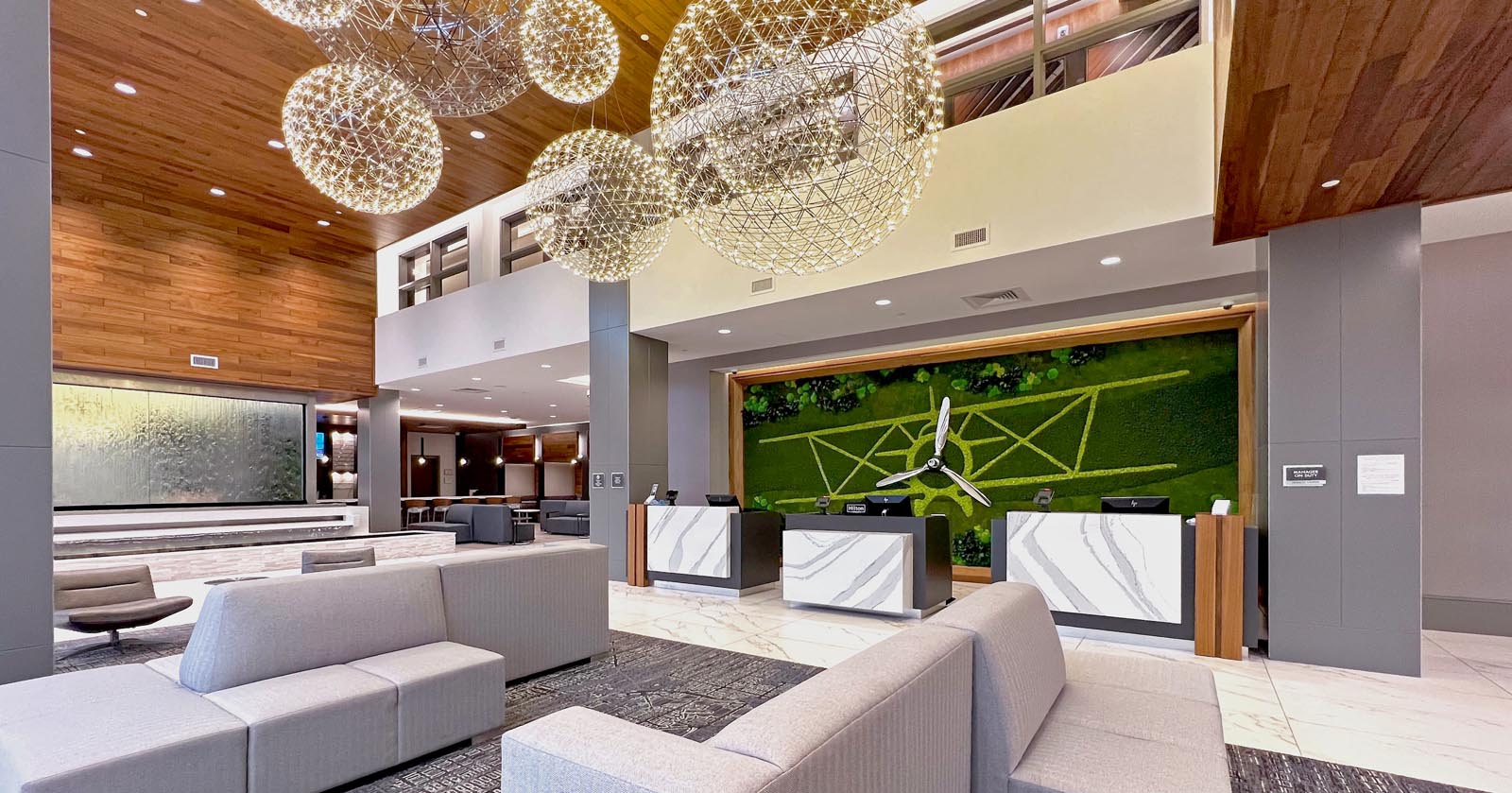
The company's emphasis on third-party testing, material transparency through Health Product Declaration v2.3 certification, and comprehensive fire safety validation including Class A ratings provides the specification confidence that CRE professionals require when implementing innovative design strategies. Their installations across Fortune 500 corporate headquarters, major healthcare systems, and aviation hubs demonstrate proven performance in precisely the high-stakes environments where connection matters most.
Long-term lifecycle performance becomes critical when evaluating connection infrastructure investments. Premium preserved gardens, moss walls and plantings from Garden on the Wall® engineered for 20+ year operational lifecycles with rejuvenation programs address the sustainability and cost-management priorities that Hoskins identifies as baseline expectations for forward-looking developments. This positions biophilic installations as permanent building infrastructure rather than temporary decorative elements.
Conclusion
Diane Hoskins concludes her analysis with an essential observation for every CRE professional: "Human connection is not an ancillary benefit of real estate - it is the core value proposition." Her article, also available at LinkedIn, provides comprehensive guidance for navigating this transformation.
The shift from efficiency-centered to engagement-centered valuation represents fundamental change in how commercial real estate creates and measures value. Properties designed to foster belonging, inspire connection, and support authentic relationships will outperform those optimized solely for traditional metrics. As Hoskins emphasizes, designing for connection isn't optional in an era increasingly defined by separation - it's essential infrastructure for commercial real estate competitiveness and long-term asset value creation. CRE professionals who recognize and implement this transformation position their properties for sustained success in an industry where human experience has become the ultimate measure of value.
For CRE professionals ready to implement connection-centered design through biophilic installations that support the metrics revolution Hoskins describes, Garden on the Wall® offers comprehensive consultation on preserved garden, moss wall and planting solutions engineered for performance, longevity, and specification confidence. Discover how strategic moss wall and preserved nature installations can transform your properties into spaces where human connection thrives - contact Garden on the Wall® to explore implementation strategies aligned with the future of commercial real estate valuation.
For more information on this subject, read this article: Biophilia and Human Connection: Bringing People Together in Post-Pandemic Workplaces and other related information, please visit our website: www.gardenonthewall.com