
The Restorative Mandate: Clinical Evidence for Biophilic Healthcare Design
Modern healthcare facilities face a convergence of pressures that are simultaneously clinical, operational, and financial. Registered nurse annual turnover rates remain among the highest of any professional sector, with replacement costs estimated at $50,000 to $70,000 per departure. Patient experience metrics now directly linked to federal reimbursement - are increasingly sensitive to the non-clinical quality of the care environment. And the scientific literature connecting the built environment to patient outcomes has reached a threshold of evidence that healthcare administrators and design teams can no longer treat as supplementary.
The clinical environment is a care delivery tool. The design of that environment is a clinical decision.
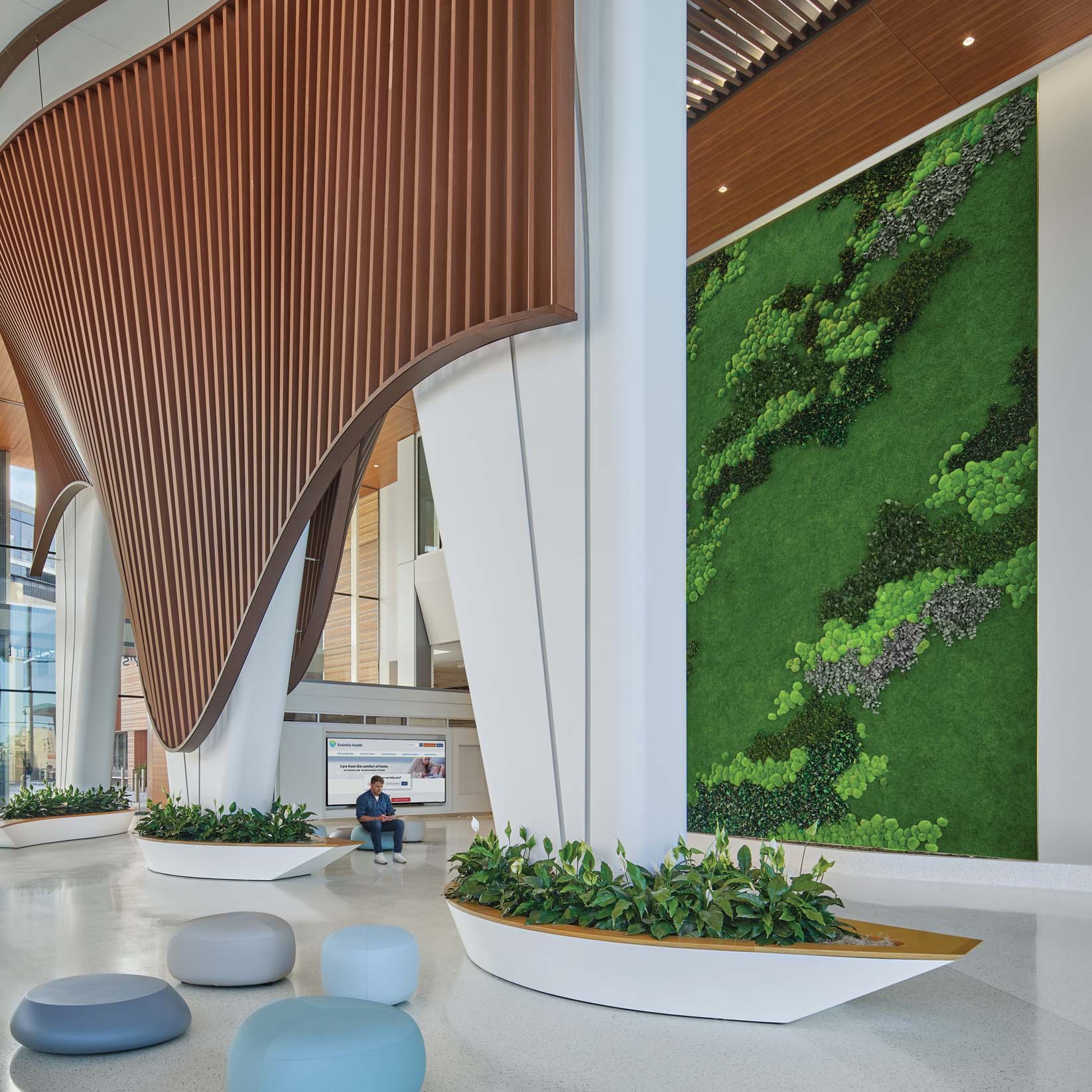
160 Years of Evidence: Nature and the Biology of Recovery
The evidence base for nature'srole in clinical recovery begins with Florence Nightingale's 1859 documentation of patient improvement in wards with access to natural light and garden views - and extends through more than a century of peer-reviewed research inenvironmental psychology, stress physiology, and evidence-based design. The foundational modern study - Ulrich's 1984 Science publication - demonstrated measurably shorter post-surgical recovery among patients with views of natural vegetation compared to those viewing a brick wall. The subsequent research has replicated and extended this finding across patient populations, acuity levels, and care settings.
Nature exposure activates the parasympathetic nervous system, reducing cortisol and epinephrine, decreasing heart rate and blood pressure, and shifting the body toward the physiological conditions that support healing. This is not a subjective comfort response. It is a measurable biological mechanism.


Clinical Outcomes: The Evidence Summary
The following table summarizesdocumented clinical outcomes from peer-reviewed evidence-based design research. These figures represent findings from hospital and ambulatory care studiesincluded in the full citation record of The Restorative Mandate:
The 2030 CMS Mandate: A Design Deadline
The CMS Hospital Value-Base Purchasing (VBP) program links a percentage of Medicare base payments to performance on patient experience metrics captured through the HCAHPS survey. Beginning FY2030, this performance-based reimbursement structure ties financialoutcomes directly to the dimensions of the clinical experience that patientsreport - including the environment of care, communication quality, and overallhospital rating.
For healthcare facility directorsand design teams, this regulatory timeline converts biophilic design from a capital improvement amenity into a reimbursement protection strategy. The specification decisions made during current and upcoming renovation and new construction cycles will be in service during the period when HCAHPS performance carries its greatest financial weight.


The Infection Control Requirement
In clinical environments - particularly high-acuity areas including ICUs, oncology units, and transplant care - the infection control profile of every specification is reviewed. Living plants and live green walls introduce documented infection vectors: soil-borne pathogens, mold colonization in irrigation systems, and pest entry. Their useis restricted and limited in clinical areas in most acute care facilities.
Preserved nature systems require zero water, zero soil, and zero irrigation. There is no moisture source and no organic substrate in which microbial growth can establish. The ASTM E84 Class 1/A fire rating is achieved by the preserved botanical material itself, without chemical flame retardant application - critical for immunocompromised patient populations who cannot be exposed to off-gassing from chemically treated materials.
The Nurse Retention Dimension
Healthcare's registered nurse turnover crisis is driven in part by burnout a physiological and psychological exhaustion that accumulates in high-stress clinical environments without adequate restorative counter-balance. Evidence-based design research demonstrates that restorative break environments - spaces where staff can experience authentic nature contact during short breaks - contribute measurably to burnout mitigation and retention.
At a replacement cost of $50,000 to $70,000 per nurse departure (Mercer, 2025), a 100-bed acute care facility experiencing average industry turnover rates faces a retention cost burden that a well-specified clinical environment can meaningfully reduce. The full financial model is detailed in the companion white paper, Designing for Recovery.

Access the Full White Paper
The Restorative Mandate — a peer-reviewedsynthesis of clinical evidence, regulatory context, and specification guidancefor healthcare environments - is available in full through the Garden on theWall® Designer Hub. The Designer Hub also provides access to the companionwhite paper Designing for Recovery, infection control documentation, technicalspecifications, and LEED/WELL compliance packages.