
Neuroinclusive Design Excellence with Preserved Gardens
Key Takeaways Before You Read the Full Article:
30 Second Executive Summary
Neuroinclusive design recognizes neurological diversity as a competitive advantage rather than a constraint. Preserved gardens, moss walls, and planter inserts create stable, sensory-supportive environments that enable neurodivergent individuals to perform at their best while improving workplace conditions for everyone.
💼 Business Impact: Inclusion as Competitive Advantage
One in seven people are neurodivergent, representing a significant portion of the talent pool with strengths in pattern recognition, focus, and problem-solving. Organizations that implement neuroinclusive environments report higher innovation, improved retention, and reduced turnover costs.
🔬 Research Foundation: Sensory Environments Shape Performance
Neurodivergent individuals often experience heightened sensitivity to visual, acoustic, and spatial stimuli. Preserved gardens and moss walls provide consistent visual anchors, calming organic patterns, and acoustic absorption that reduce sensory overload and support cognitive regulation.
🎯 Strategic Implementation: Stability, Predictability, and Choice
Unlike living systems, preserved gardens maintain a consistent appearance and require no maintenance-related disruptions. Strategic placement in quiet zones and transition areas supports sensory regulation while allowing neurodivergent employees to remain connected to the broader workplace.
📊 Universal Benefit: Neuroinclusive Design Helps Everyone
Environments designed for neurodivergent success improve focus, stress management, collaboration, and attention restoration across all users. Neuroinclusive strategies consistently elevate overall workplace performance, not just accommodation outcomes.
Ready to design spaces where every mind can thrive? The full article outlines how preserved gardens and moss walls support neuroinclusive workplaces that unlock the full spectrum of human cognitive potential.
Neuroinclusive Design Excellence: Creating Spaces for Neurodivergent Success Through Preserved Gardens
One in seven people are neurodivergent - here's how preserved gardens with moss walls and planter inserts crafted with preserved foliage create inclusive environments where every mind can thrive. As workplace diversity encompasses neurological differences alongside traditional diversity metrics, forward-thinking organizations recognize that neuroinclusive design isn't just ethical imperative - it's competitive advantage that unlocks the innovative potential of neurodivergent talent while creating better environments for everyone.
Understanding Neurodiversity: The Spectrum of Human Cognitive Experience
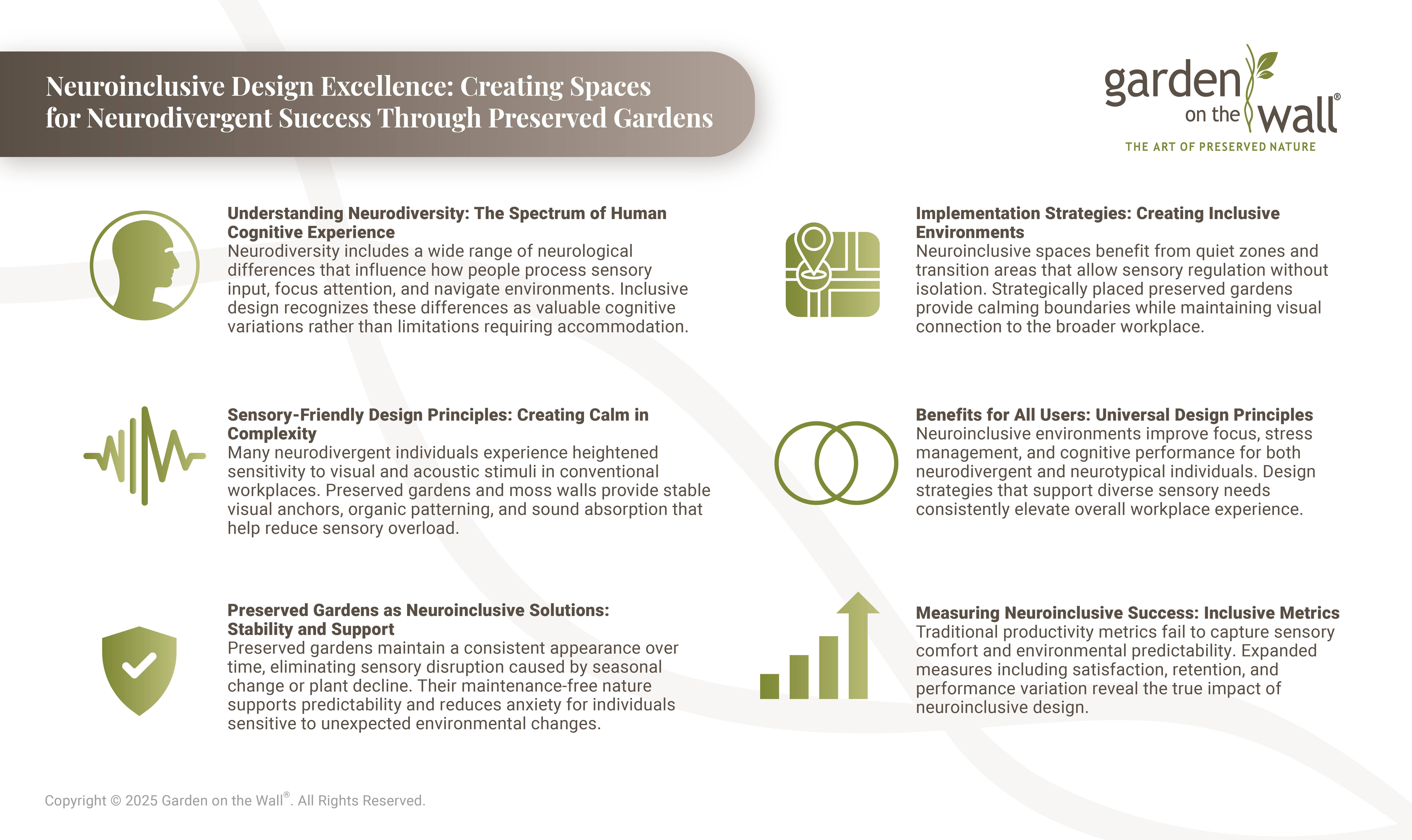
Neurodiversity encompasses a broad spectrum of neurological differences including autism spectrum disorders, ADHD, dyslexia, dyspraxia, and other conditions affecting how individuals process sensory information, manage attention, and interact with their environments. Rather than viewing these differences as deficits requiring accommodation, progressive organizations embrace neurodiversity as cognitive variation that brings unique strengths and perspectives to workplace innovation.
Research consistently demonstrates that neurodivergent individuals often excel in pattern recognition, systematic thinking, attention to detail, and creative problem-solving capabilities that drive innovation across industries from technology to finance. However, conventional workplace designs frequently create sensory environments that overwhelm neurodivergent nervous systems, preventing these individuals from performing at their potential.
The business case for neuroinclusive design extends beyond ethical considerations to encompass tangible competitive advantages. Organizations successfully attracting and supporting neurodivergent talent report enhanced innovation rates, improved problem-solving capabilities, and reduced turnover costs. Companies like Microsoft, SAP, and JPMorgan Chase actively recruit neurodivergent employees while investing in workplace modifications that support their success.
Sensory-Friendly Design Principles: Creating Calm in Complexity
Neuroinclusive design requires understanding how sensory environments affect different nervous systems. Visual anchors become crucial elements, providing stable reference points that help individuals with spatial processing differences navigate complex environments. Preserved gardens with moss walls excel as visual anchors because they maintain consistent appearance over time, eliminating the sensory disruption caused by changing or deteriorating installations.
The natural patterns found in preserved gardens and moss walls support cognitive processing for many neurodivergent individuals. Research indicates that organic, fractal patterns can be soothing and organizing for minds that struggle with chaotic or overly geometric environments. These patterns provide visual information that feels comprehensible and manageable rather than overwhelming.
Acoustic considerations become particularly important for neurodivergent individuals who may experience sound sensitivity or auditory processing differences. Preserved gardens with planter inserts provide natural sound absorption that helps create quieter zones within larger spaces, offering respite from potentially overwhelming ambient noise while maintaining connection to collaborative environments.
Preserved Gardens as Neuroinclusive Solutions: Stability and Support
Preserved gardens and moss walls offer unique advantages for neuroinclusive design through their combination of natural elements and environmental predictability. Unlike living plants that change seasonally or may show signs of distress, Garden on the Wall®'s preserved installations maintain consistent visual and tactile properties that support individuals who rely on environmental predictability for optimal functioning.
The maintenance-free nature of preserved gardens with planter inserts eliminates sensory disruptions from care activities that might distress individuals sensitive to unexpected sounds, movements, or chemical odors. This stability allows neurodivergent individuals to develop reliable relationships with their environments without anxiety about unexpected changes or maintenance intrusions.
Multi-sensory engagement opportunities through preserved gardens and moss walls can support diverse sensory processing needs. Some neurodivergent individuals seek additional sensory input to maintain optimal arousal levels, while others require sensory reduction to prevent overwhelm. The biophilic benefits - including stress reduction and attention restoration - prove particularly valuable for neurodivergent individuals who may experience higher baseline stress levels.
Implementation Strategies: Creating Inclusive Environments
Successful neuroinclusive design requires strategic approaches that balance diverse sensory needs while maintaining functional workplace environments. Creating dedicated quiet zones enhanced with preserved gardens and moss walls provides essential retreat spaces where neurodivergent individuals can regulate sensory input and recover from overstimulation without leaving the workplace entirely.
These quiet zones should be positioned away from high-traffic areas and mechanical noise sources while maintaining visual connection to the broader workspace. Preserved gardens with moss walls can provide natural boundaries that create privacy without complete isolation, supporting both sensory regulation needs and social inclusion objectives.
Gradual sensory transitions between different environmental zones help neurodivergent individuals manage changing sensory demands throughout their workday. Garden on the Wall®'s preserved gardens with planter inserts positioned at transition points can signal environmental changes while providing calming visual anchors that support successful navigation between different space types.
Benefits for All Users: Universal Design Principles
Neuroinclusive design improvements benefit entire organizations, not just neurodivergent individuals. The sensory regulation opportunities provided by preserved gardens and moss walls support stress management for all employees, particularly during high-pressure periods or demanding projects. Enhanced creativity and problem-solving capabilities emerge when organizations remove environmental barriers that constrain cognitive performance.
Improved focus and concentration benefits extend throughout neurodivergent and neurotypical populations. The attention restoration opportunities provided by preserved gardens with planter inserts help all employees maintain peak cognitive performance throughout demanding workdays, while the stress reduction benefits support better decision-making across diverse thinking styles.
Team collaboration improvements are achieved in the environments support diverse communication and interaction preferences. Preserved gardens and moss walls can create semi-private spaces that facilitate different collaboration styles, from quiet one-on-one discussions to dynamic group brainstorming, accommodating various comfort levels and interaction needs.
Measuring Neuroinclusive Success: Inclusive Metrics
Evaluating neuroinclusive design effectiveness requires metrics that capture diverse experiences and outcomes. Employee satisfaction surveys should include questions specifically addressing sensory comfort, environmental predictability, and access to regulation opportunities rather than relying solely on traditional workplace satisfaction indicators.
Performance metrics should account for diverse working styles and strengths rather than measuring only conventional productivity indicators. Organizations implementing neuroinclusive design often discover that neurodivergent employees excel in areas like quality control, pattern recognition, and systematic analysis when provided with supportive environments.
Retention rates among neurodivergent employees provide crucial feedback about environmental effectiveness, while innovation metrics often increase following neuroinclusive design implementation as diverse cognitive approaches contribute to enhanced organizational problem-solving capabilities.
Future of Neuroinclusive Workplaces: Evolving Understanding
As research advances our understanding of neurodiversity and effective support strategies, preserved gardens with moss walls will likely play expanding roles in neuroinclusive design. Their adaptability and longevity make them ideal foundations for evolving accommodation strategies as individual and organizational needs develop.
Technology integration opportunities may enhance the neuroinclusive benefits of preserved gardens and planter inserts through features like adjustable lighting or integrated sound management systems that respond to individual sensory preferences while maintaining the natural aesthetic that provides core biophilic benefits.
Conclusion: Creating Truly Inclusive Workspaces
Creating truly inclusive workspaces represents both ethical imperative and business opportunity. Garden on the Wall®'s preserved gardens, moss walls, and planter inserts provide practical tools for developing environments where neurodivergent individuals can thrive while creating better spaces for everyone. As understanding of neurodiversity deepens, these installations will continue serving as foundational elements in workplaces designed to unlock the full spectrum of human cognitive potential through their proven track record of over 1,880 successful projects since 2014.
For more information on this subject, read this article: How Biophilic Design Enhances Cognitive Function and Creativity and other related information, please visit our website: www.gardenonthewall.com

_1.jpg)
