Biomimetic Engineering: How Nature's Patterns Inspire Revolutionary Preserved Garden Installation Systems
Key Takeaways Before You Read the Full Article:
30 Second Executive Summary
Biomimetic engineering uses nature’s structural intelligence to improve the durability, adaptability, and efficiency of preserved garden installation systems. By studying roots, branching networks, cellular structures, and natural interfaces, designers and engineers can develop mounting and connection strategies that perform more reliably over time.
⚙️ Engineering Innovation: Learning From Nature’s Structural Systems
Natural systems distribute loads, adapt to change, and maintain stability through redundancy. Biomimetic engineering applies these strategies to preserved garden mounting and installation technology.
🏗️ Structural Performance: Smarter Load Distribution
Root systems and fractal branching patterns provide models for distributing weight across multiple connection points. These strategies help reduce concentrated stresses while improving long-term installation stability.
🧩 Installation Efficiency: Complex Results From Simple Rules
Self-organizing systems demonstrate how sophisticated patterns can emerge from repeatable structural principles. Biomimetic approaches can simplify installation while maintaining organic visual complexity.
🔗 Adaptive Connections: Designing for Change
Nature-inspired interfaces combine flexibility with secure attachment. These connection strategies help preserved garden systems accommodate movement, environmental variation, and future reconfiguration.
🚀 Future Potential: Intelligent Nature-Inspired Infrastructure
Emerging biomimetic technologies may integrate sensors, monitoring, and adaptive systems into preserved garden installations. Nature’s engineering principles provide a foundation for increasingly sophisticated biophilic infrastructure.
Ready to explore how nature’s own engineering strategies can influence the next generation of preserved garden systems? The full article examines how biomimicry can improve mounting, material integration, adaptability, and long-term installation performance.
Understanding Biomimetic Principles in Preserved Garden Technology
Biomimetic engineering applies nature's time-tested solutions to human design challenges, drawing inspiration from millions of years of evolutionary optimization to create superior installation systems for preserved gardens and moss walls. Natural systems demonstrate remarkable efficiency, durability, and adaptability through structural principles that engineers increasingly adopt for commercial applications requiring long-term performance and minimal maintenance. The integration of biomimetic principles in preserved garden installation technology represents a revolutionary approach that enhances both aesthetic appeal and functional performance through nature-inspired solutions.
Nature's engineering solutions excel in areas where human installations often struggle, including stress distribution, environmental adaptation, self-organization, and resource efficiency that preserved garden systems must achieve for commercial success. Tree root systems, mycelial networks, and cellular structures provide proven models for creating mounting systems that distribute loads effectively while maintaining flexibility and adaptability essential for long-term installation success. These natural patterns offer superior alternatives to traditional engineering approaches that often create rigid systems prone to failure under environmental stress.
The application of biomimetic principles to preserved garden installation systems enables the creation of mounting solutions that achieve superior performance through distributed load management, adaptive flexibility, and integrated redundancy that mirrors natural structural systems. By understanding and applying nature's engineering principles, installation systems can achieve the reliability and longevity that commercial applications demand while maintaining the aesthetic integrity essential for successful biophilic design implementation.
Structural Biomimicry in Mounting System Design
Tree attachment mechanisms provide exceptional models for preserved garden mounting systems that must secure substantial installations while accommodating building movement, thermal expansion, and long-term settlement without compromising structural integrity. Root systems demonstrate distributed attachment strategies that spread loads across multiple connection points rather than concentrating stress in single locations that create failure risks. This distributed approach enables preserved garden installations to achieve superior stability while minimizing stress concentrations that could cause mounting failures over time.
The branching patterns found in natural systems offer optimal solutions for weight distribution in large preserved garden installations that must transfer loads from wall surfaces to structural building elements safely and efficiently. Fractal branching patterns, where smaller branches progressively distribute loads from larger primary structures, provide mathematical models for creating mounting systems that achieve uniform load distribution while minimizing material usage and installation complexity.
Adaptive connection strategies observed in natural attachment systems enable preserved garden installations to accommodate environmental changes including thermal cycling, humidity variations, and building movement without creating stress concentrations that compromise long-term stability. Flexible connection elements that allow controlled movement while maintaining secure attachment mirror natural joint systems that provide both stability and adaptability essential for long-term performance in dynamic commercial environments.
Self-Organization Principles and Installation Efficiency
Natural self-organization principles offer revolutionary approaches to preserved garden installation that minimize human intervention while achieving optimal aesthetic and functional outcomes through system-level organization strategies. Cellular organization patterns found in natural moss formations provide models for creating preserved garden installations that appear naturally organized rather than artificially imposed, enhancing visual authenticity while simplifying installation procedures.
Emergent pattern formation in natural systems demonstrates how complex, beautiful arrangements can arise from simple organizational rules applied consistently across installation areas. These principles enable preserved garden installations to achieve visual complexity and natural appearance through systematic application of biomimetic organization strategies rather than requiring custom design for each installation section. The result is reduced installation time and cost while achieving superior aesthetic outcomes.
Network topology principles from natural distribution systems provide optimal solutions for utility integration including electrical connections for accent lighting and sensor systems that enhance preserved garden functionality. Natural network patterns achieve efficient resource distribution while maintaining redundancy and fault tolerance essential for reliable system operation in commercial environments where maintenance access may be limited.
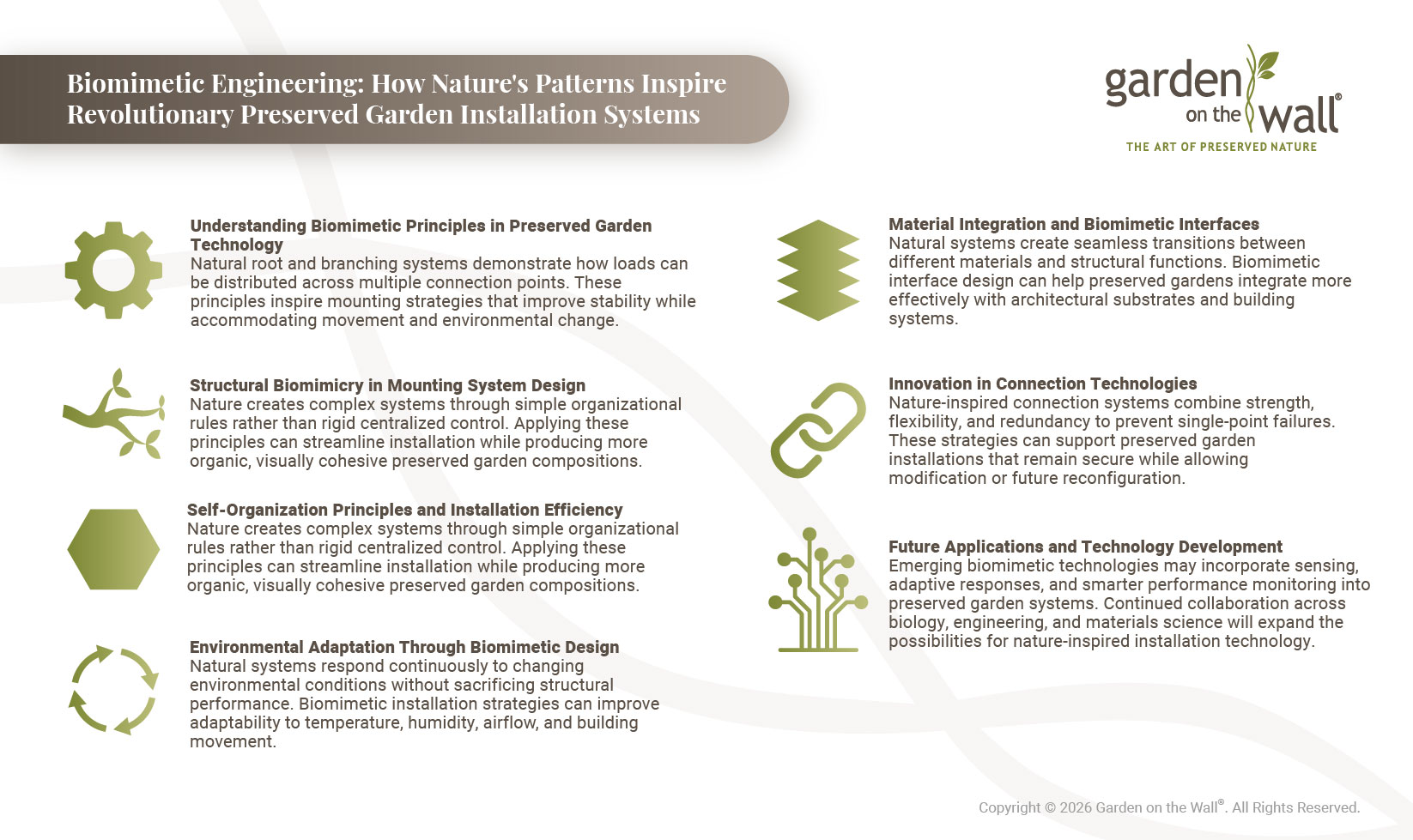
Environmental Adaptation Through Biomimetic Design
Natural systems excel at environmental adaptation through structural and material strategies that enable survival and optimal performance across varying environmental conditions. Preserved garden installation systems can incorporate these adaptive strategies to ensure consistent performance regardless of indoor environmental variations including temperature fluctuations, humidity changes, and air circulation patterns that affect installation longevity and appearance.
Surface texture strategies observed in natural moss and plant structures provide optimal solutions for preserving visual authenticity while achieving the mechanical properties necessary for commercial installation success. Natural surface patterns that provide grip, moisture management, and visual complexity offer models for creating preserved garden surfaces that maintain authentic appearance while providing the durability and stability required for long-term commercial applications.
Microclimate management strategies from natural systems enable preserved garden installations to create optimal local environmental conditions that enhance longevity and visual appeal without requiring complex mechanical systems. Natural principles of air circulation, thermal regulation, and moisture management can be incorporated into installation design to optimize preserved garden performance while minimizing maintenance requirements and operational complexity.
Material Integration and Biomimetic Interfaces
Natural interface design between different materials and structures provides optimal models for integrating preserved gardens with existing building systems while maintaining both aesthetic continuity and functional performance. The seamless transitions found in natural systems where different materials meet offer superior alternatives to traditional construction joints that often create visual disruptions and potential failure points in commercial installations.
Composite material strategies from natural systems demonstrate how different material properties can be combined to achieve superior overall performance while maintaining visual cohesion essential for successful biophilic design implementation. Natural composites achieve combinations of strength, flexibility, and aesthetic appeal that engineered systems struggle to match through conventional approaches, providing models for advanced preserved garden mounting and integration systems.
Adhesion strategies from natural systems offer revolutionary approaches to preserved garden attachment that eliminate mechanical fasteners while achieving superior long-term reliability and aesthetic integration. Natural adhesion mechanisms provide both immediate bonding strength and long-term durability through molecular-level interfaces that adapt to environmental conditions while maintaining secure attachment throughout extended service periods.
Innovation in Connection Technologies
Biomimetic connection technologies draw inspiration from natural joining mechanisms that achieve exceptional strength, durability, and aesthetic integration through evolved interface strategies. Natural systems demonstrate connection approaches that distribute stress effectively while maintaining flexibility and allowing for environmental adaptation essential for long-term performance in dynamic commercial environments.
Reversible connection strategies from natural systems enable preserved garden installations that can be modified, expanded, or relocated without damage to building surfaces or installation components. These approaches provide operational flexibility essential for commercial environments where space usage may change over time while maintaining the aesthetic and functional benefits of preserved garden installations.
Integration redundancy principles from natural systems ensure that preserved garden installations maintain stability and appearance even if individual connection points experience stress or failure. This systematic redundancy approach mirrors natural strategies that prevent catastrophic failure through distributed backup systems that maintain overall system integrity and performance.
Future Applications and Technology Development
Advanced biomimetic engineering continues developing installation technologies that incorporate increasingly sophisticated natural principles including adaptive responses, self-healing capabilities, and optimization strategies that enable preserved garden systems to improve performance over time. These emerging technologies represent the future of preserved garden installation systems that achieve superior performance through deep understanding and application of natural engineering principles.
Smart integration capabilities enable preserved garden installations to incorporate sensing, monitoring, and adaptive response systems inspired by natural feedback mechanisms that optimize performance in response to environmental conditions and usage patterns. These technologies enhance installation effectiveness while providing data-driven insights that support optimization and maintenance planning for maximum long-term value.
Research and development in biomimetic installation technologies continues advancing through collaboration between materials scientists, engineers, and biologists who study natural systems to identify optimal principles for commercial application. Garden on the Wall®'s commitment to innovation ensures continued development of superior installation technologies that incorporate the latest biomimetic engineering advances while maintaining the reliability and aesthetic excellence required for commercial success.
The future of preserved garden installation systems lies in comprehensive application of biomimetic principles that achieve superior performance through nature-inspired engineering solutions. These approaches provide competitive advantages through enhanced reliability, simplified installation, and optimal aesthetic integration that supports the growing demand for sophisticated biophilic design solutions in commercial environments.
For more information on this subject, read this article: What is Biomimetics and How Does it Relate to Biophilic Design and other related information, please visit our website: www.gardenonthewall.com.